
Santiago de Compostela is about an hour and a half from our village in the Ribeira Sacra, and the cathedral at its heart is the reason the city exists at all. It is the final destination of the Camino de Santiago, the endpoint for pilgrims who have walked for weeks or months, and one of the most important religious buildings in Europe. This article draws on published historical sources rather than firsthand research, so treat the dates and details as a general introduction rather than the final word.
Why the Cathedral Was Built Here
The story starts in the early 9th century, when a tomb was discovered in this part of Galicia that was believed to hold the remains of the apostle James. King Alfonso II travelled to confirm the find and had a small chapel built on the spot, which made him, according to tradition, the first pilgrim to Santiago. That original church was destroyed in 997 during a raid by the Moorish military leader Al-Mansur, though the tomb itself was left untouched. Construction of the cathedral that stands today began in 1075 under King Alfonso VI and Bishop Diego Peláez, with the main structure consecrated in 1211.
Word of the relics spread across medieval Europe, and Santiago became one of three major Christian pilgrimage destinations alongside Jerusalem and Rome. The network of walking routes that grew out of this, the Camino de Santiago, still brings hundreds of thousands of people to the city’s cathedral doors every year.
Architecture: Romanesque Bones, Baroque Skin
The cathedral is, at its core, a Romanesque building, and architectural historians consider it one of the finest examples of the style anywhere. Over the centuries it picked up additions in Gothic, Baroque, and neoclassical styles, so what visitors see today is really several centuries of building layered on top of each other.
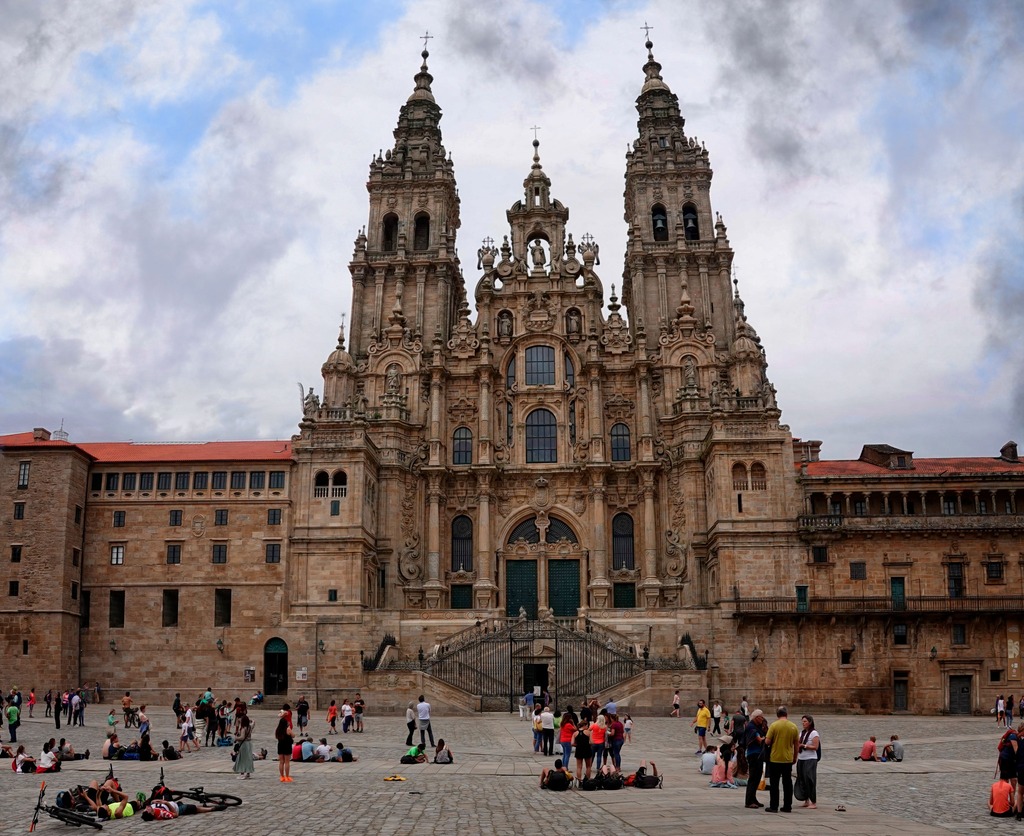
The most photographed part is the Obradoiro facade, the granite Baroque front facing the main square, completed in the 18th century. It is dramatic and ornate, and it is easy to forget that behind it sits a much older Romanesque structure.
Inside the west end is the Pórtico da Gloria, carved in the 12th century under the direction of Master Mateo. It holds around 200 carved figures and is generally regarded as one of the masterpieces of Romanesque sculpture in Europe. Access to see it up close usually requires a separate ticket, since it has been under long-term conservation.
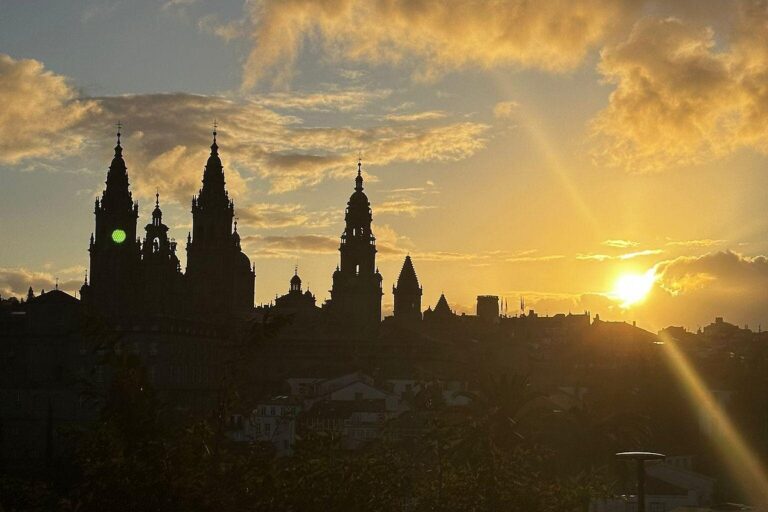
The cathedral’s bell and clock tower, known as the Berenguela, is another distinctive feature of the skyline, visible from various points around the old town.
The Botafumeiro
One detail that tends to surprise first-time visitors is the Botafumeiro, a giant incense burner that is swung on ropes across the transept during certain masses, reaching considerable speed and height. It is not part of every service, so if seeing it is a priority, it is worth checking the schedule in advance or asking at the cathedral.
Visiting the Cathedral
A few practical points that are worth knowing before a visit:
- Pilgrim’s Mass: held daily, and it is the moment many pilgrims consider the true end of their Camino.
- Holy Years: when the feast day of Saint James, 25 July, falls on a Sunday, it is celebrated as a Holy Year (Año Santo), with additional traditions and larger crowds.
- Tickets: general entry to the cathedral is free, but certain areas, such as the Pórtico da Gloria, the museum, and the rooftop tours, require separate paid tickets.
- Crowds: the cathedral and the surrounding old town get busy, particularly around midday and during the summer pilgrimage season. Early morning is quieter.
Combining It With the Rest of Galicia
Most visitors treat Santiago as a city trip on its own, but for anyone already exploring the Ribeira Sacra or the rest of Lugo province, it is an easy day trip by car. We would suggest pairing it with a wander through the old town’s granite streets and arcades, which is a proper piece of Galician heritage in its own right, rather than trying to see the cathedral as a rushed stop between other plans.