
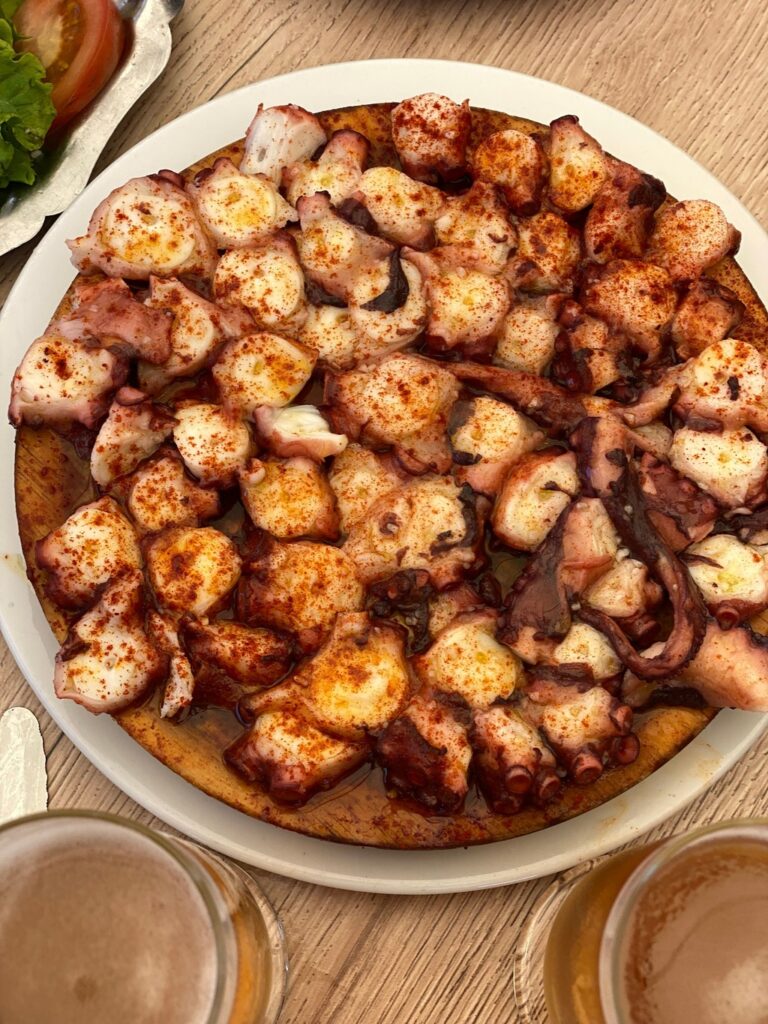
If there is one dish that sums up Galicia, it is pulpo a feira. Boiled octopus, sliced into rounds, laid out on a wooden plate, and finished with olive oil, coarse sea salt, and a dusting of pimentón. No sauce, no fuss, nothing to hide behind. The dish either works or it does not, and in Galicia it almost always works.
We had our first proper pulpo in O Carballino, which is not a coincidence. The town holds one of the biggest octopus festivals in all of Galicia, the Festa do Polbo, and its pulpeiras have a reputation to match. There was a woman standing over a huge copper pot, working through octopus after octopus with the kind of ease that only comes from doing something for decades. She would lift each one out, dunk it briefly back into the boiling water two more times, then let it rest before cutting it with scissors straight onto the wooden board. No thermometer, no recipe card, just years of muscle memory.
That three-times-dunking step is called assustar, which roughly translates to startling the octopus. The idea is that the sudden shifts in temperature help keep the skin intact and make the texture more tender once it is fully cooked. Whether that is culinary science or tradition dressed up as science, we could not say, but the result speaks for itself. The texture should be firm but not rubbery, with a slight give when you bite into it.
Interestingly, most pulpeiras use frozen octopus rather than fresh. Freezing breaks down the muscle fibers in a way that makes the meat more tender, so what sounds like a shortcut is actually part of getting the dish right. The copper pot matters too, at least according to the people who have been doing this their whole lives, though we suspect the real magic is simply repetition and attention rather than the metal itself.
Ribeira Sacra does not sit on the coast, so the octopus itself is never local here. What is local is the ritual around it. Pulpo a feira shows up at nearly every village festival in this region, usually served alongside crusty bread and a glass of Ribeiro or Godello. It is street food and celebration food at once, eaten standing up off a wooden board with a toothpick, often with strangers pressed shoulder to shoulder around the same stall.
O Carballino and Melide, a stop along the Camino de Santiago, are usually named as the two places to go for the best pulpo in Galicia, and both have earned that reputation over generations of pilgrims and festival-goers passing through. But you do not need to travel to either to find it done well. Village feasts throughout Ourense province, including here in the Ribeira Sacra, often have at least one stall doing the same thing, sometimes better, without any of the fame.
If you find yourself at a Galician festival and see a large copper pot with a queue in front of it, that is where you want to be standing.