We almost drove past Fervenza de Fondós the first time, and in a way that is the whole point of the place. It sits tucked into the parish of Erbedeiro, in the municipality of Carballedo, in the Chantada area of Lugo province, on a stretch of road that curves down toward the Miño canyon. We have lived in Galicia for five months now, and this stretch of road is still one of the more dramatic ones we have driven. Steep hillsides drop away on one side, quartzite cliffs rise on the other, and the Miño appears far below as a thin green ribbon between forested slopes. For a few kilometres it does not look like the Galicia most people picture. It looks more like a back road in Austria or a valley in Switzerland, without the alpine peaks but with a lot more oak and pine.
Getting there is straightforward if you know which road to take. From Chantada you follow the road toward Os Peares, or alternatively you can descend into the canyon from A Barrela, also in Carballedo. Either way you end up on the LU-P-1801, and it is on a bend of that road, just past Erbedeiro, that the waterfall reveals itself. There is a small pull-in right along the road where you can park, big enough for a couple of cars and no more, so if it is occupied you may have to wait or find a spot a little further along. An information panel marks the spot, next to an enormous wall of rock that is hard to miss once you are standing next to it.
Along the way we crossed paths with two different waymarked routes, which surprised us a little given how quiet this stretch of road usually is. The first is part of the Camino de Invierno, the Winter Way to Santiago, which historically followed a secondary Roman route between Braga and Astorga and still threads through this section of the Ribeira Sacra before crossing the Miño over the old bridge at Belesar. We saw the yellow arrows a few times without setting out to look for them, which is usually a sign that a place has more layers to it than a quick stop suggests. The second is the signposted walking route along the Ribeira Sacra do Miño, which runs through Erbedeiro and continues toward viewpoints further along the canyon, including the Mirador do Castelo das Marabillas near Pantón. That one is not a stroll. It is unpaved in places, overgrown in others, and definitely not a route you want to attempt in sandals, but if you have proper boots and a free afternoon it rewards you with views over the canyon that the waterfall itself cannot give you. There is also a short, easy circular path right at the waterfall, well under two kilometres, that loops past the rock face and back to the parking area in about half an hour, useful if you only have a few minutes to spare.
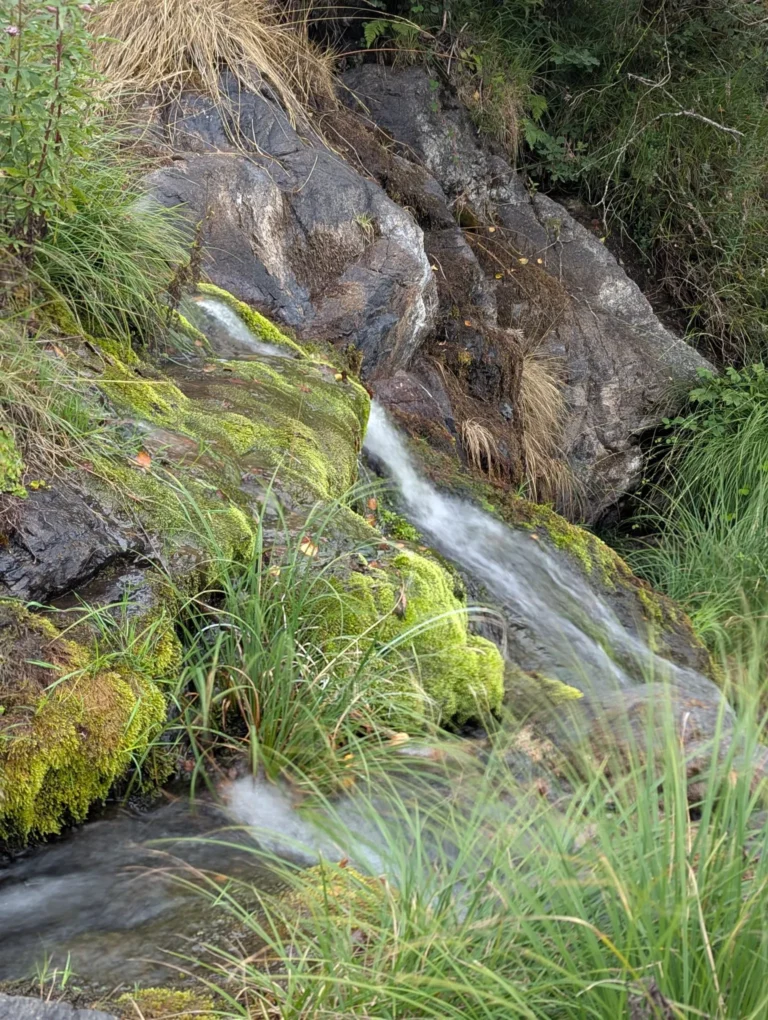
And here we have to be factual about the waterfall itself: it is small. The Fondós, also known locally as the río de Pepes, drops over a short stretch of quartzite before joining the Miño, and depending on the season and recent rainfall it can be little more than a trickle rather than a dramatic cascade. Standing at the parking area, with the water mostly screened by pine trees, it is easy to wonder why the spot is signposted at all.
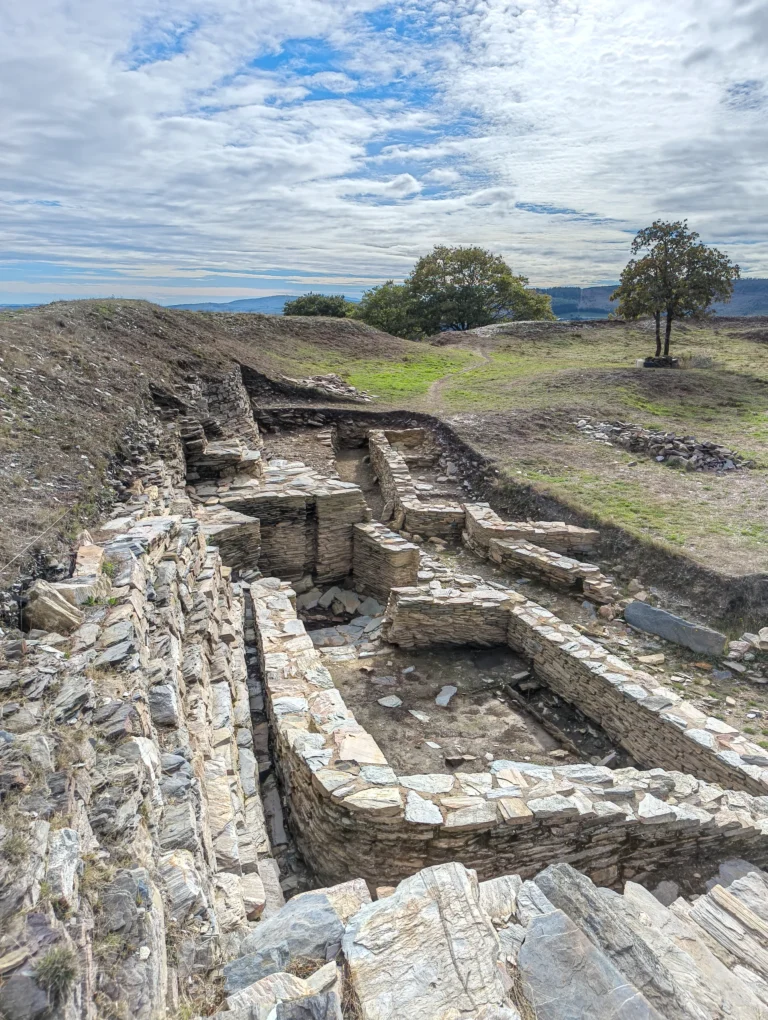
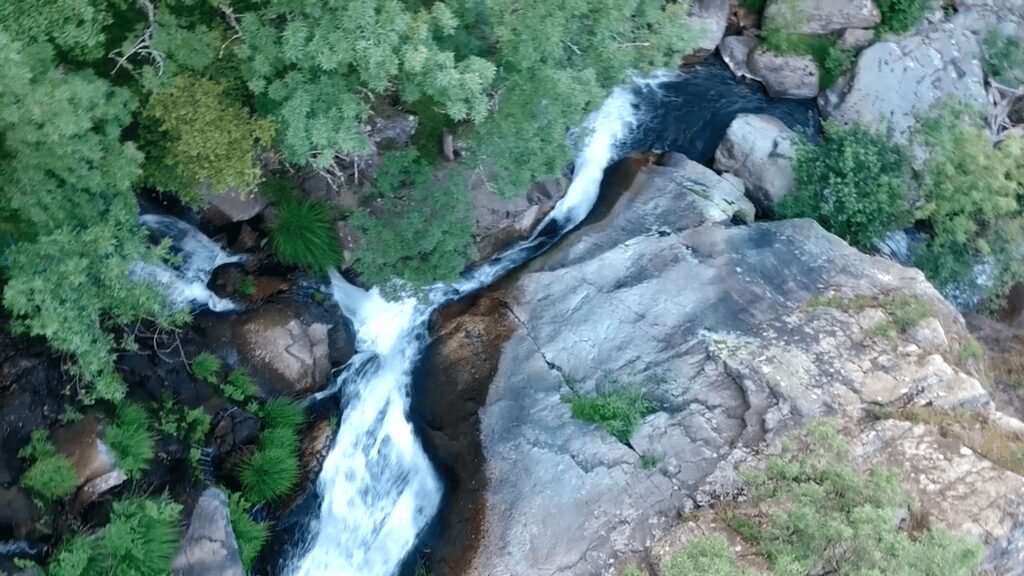
The reason becomes clearer once you look at the terrain rather than just the water. The rock beside the falls, known as the Penedo do Graúllo or Garabullo, is a large outcrop of Armorican quartzite reaching roughly 444 metres in altitude, and between this rock and the Miño the river drops from around 450 metres to about 200 metres in under a kilometre, which is why the water forms a series of small cascades rather than one clean drop. The slope also carries a patch of holm oak and cork oak, unusual for this part of Lugo and closer to what you would expect further south. None of this is visible from the parking area itself. From the road you see one rock face and one narrow cascade, not the ravine, the drop, or how the whole formation feeds into the Miño canyon below. This is where the drone earned its place in the bag. From above, the small trickle of water turns out to be one part of a much larger, steep-sided ravine, and the quartzite wall that looks unremarkable from the car turns out to be the reason this stretch of the Miño looks the way it does. We keep the site free of personal photos, landscape and drone footage only, but here the drone was not decorative. It was the only way to actually see what we had driven out to see.
The Penedo do Graúllo has one more use we had not expected, which is climbing. The quartzite here is solid and has the kind of clean vertical faces that draw climbers, and we saw gear and chalk marks on parts of the rock that made it clear this is an active local crag, not just a scenic backdrop. We are not climbers ourselves, so we cannot tell you route grades or which faces are best, but if that is your sport, this is worth a look, and the same small parking area along the LU-P-1801 will get you there.
If you are planning a day around the Ribeira Sacra del Miño rather than the more visited Ribeira Sacra del Sil, Fervenza de Fondós is worth building into the route, not as a destination on its own but as one stop among several. Combine it with the viewpoints further along toward Belesar and Os Peares, or with a short stretch of the Camino de Invierno if you want to walk rather than drive. Bring proper footwear if you intend to do more than look at the waterfall from the car, and do not expect the falls themselves to be the highlight. The road, the canyon, and the view you only get once you leave the parking area behind, that is where this place actually delivers.