

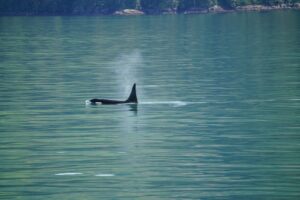
Orcas Off the Galician Coast
We live inland, in the Ribeira Sacra, so the orcas that have made headlines along the Galician and Iberian coastline are not something we have encountered ourselves. But it is a topic that comes up often enough among people considering a move to coastal Galicia, or who plan to sail or fish here, that it seems worth explaining plainly.
Since 2020, a small population of around fifty orcas has been interacting with sailboats and, increasingly, larger vessels along the coasts of Galicia, Portugal, and the Strait of Gibraltar. The behaviour is unusual: the orcas target rudders specifically, pushing and ramming them until steering is lost, while largely ignoring the hull or bow of the boat. Hundreds of these interactions have now been recorded, and a handful of vessels have sunk as a result, though there have been no reported human injuries. Researchers who study the population, including biologists at CEMMA who monitor Galician waters, are careful to describe these as interactions rather than attacks. Nothing about the behaviour resembles hunting, and most researchers believe it is a learned, social behaviour that has spread through the group, possibly starting as play or following an incident with a boat that one or two individuals experienced badly.
The interactions follow a seasonal pattern. Most occur between May and October, with the highest concentration in summer, and they tend to happen in deeper water where the orcas are following bluefin tuna, their preferred prey. This matters for the Galician coastline specifically: unlike the gentler seabed of somewhere like the Gulf of Cádiz, the coast here is rockier and drops off more steeply, so the usual advice to stay in shallow water is harder to follow in practice.
For anyone planning to sail or charter a boat along this coast, the guidance from Spanish maritime authorities and organisations like the Grupo de Trabajo Orca Atlántica is consistent: avoid areas with recent reported sightings if possible, cut the engine and let the rudder move freely if orcas approach, avoid loud noise or sudden manoeuvres, and report the interaction to the coast guard on VHF channel 16. Authorities have occasionally imposed temporary sailing restrictions for smaller vessels in the most active zones, usually lifted after a few weeks.
For people simply living near or visiting the coast rather than sailing, this is not something that affects day-to-day life. The interactions are specific to vessels underway in open or deeper water; there have been no reports of orcas approaching swimmers or people on shore. It is, in other words, a sailor’s and fisherman’s concern rather than a coastal-resident’s one, though it is the kind of thing that comes up in local conversation and in the news often enough that it is useful to understand.