
Summer time. Fiësta time!
We noticed it within our first few weeks in Ribeira Sacra. Someone would mention, almost in passing, that there was a fiesta that weekend, and we would ask which town, only to be told it did not really matter, because there would be another one somewhere close by the week after. That is how summer works here. It is not a single event to circle on a calendar. It is a season that runs from June through September where practically every village, no matter how small, has its turn to celebrate.
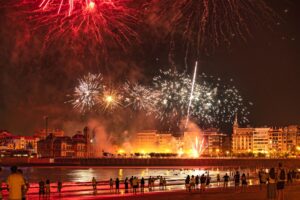
The pattern is almost always the same, and once you understand it, it makes sense of a lot of things you notice living here, like why a normally quiet village suddenly has strings of lights across the main street, or why you hear brass bands practicing on a Tuesday evening. Most villages hold what is called a fiesta patronal, a celebration built around the local patron saint. These are not tourist events. They exist because the town has always held them, and they will keep being held whether or not anyone from outside shows up. What you get is a mix of a religious procession, a market, food stalls, and in the evening a verbena, the open air dance with a live orchestra that is as much a fixture of Galician summer as the fiestas themselves. We went to our first one expecting a quiet, folkloric affair and left well past midnight with our ears still ringing from the fireworks.
Beyond the village fiestas, there is a whole layer of larger cultural celebrations tied to specific cities. Santiago de Compostela has its Fiestas del Apóstol around the feast of Santiago in July, widely considered the most international of Galicia’s festivals given how many pilgrims and visitors are already passing through the city at that time of year. A Coruña spends most of August around its Fiestas de María Pita, named after the local heroine who defended the city from an English attack in the sixteenth century, with concerts in the square that carries her name and a genuinely festive atmosphere along the seafront promenade. Vigo and Ferrol have their own versions later in the summer, each with the same ingredients of concerts, fireworks, and crowds that spill out well past the historic centers.
For anyone whose interest runs more toward music than processions, Galicia’s summer festival calendar has grown into something quite serious. Ortigueira, held on the north coast around the second weekend of July, has built a forty year reputation as one of Europe’s reference points for Celtic music, which says something about how deep the Galician connection to Celtic heritage runs. PortAmérica, in Caldas de Reis, pairs an eclectic music lineup with a strong food culture, reflecting how central eating well is to any Galician gathering, festival or otherwise. And Sinsal, held partly on the small island of San Simón in the Vigo estuary, has built a reputation on keeping its lineup secret until the last moment, which tells you something about the kind of audience it attracts.
Then there are the gastronomic fiestas, which for us have turned out to be the most interesting way to understand a place through what it eats. The Festa do Albariño in Cambados, usually the first weekend of August, is the best known of these, three days built entirely around the local white wine that has become one of Galicia’s most recognized exports. But almost every product Galicia is known for has its own dedicated fiesta somewhere on the calendar, from octopus to cheese to seafood, and these smaller, more local celebrations are often where you get the clearest sense of a town’s identity, without the crowds of the bigger names.
Living inland, in Ribeira Sacra, we have found that the biggest festivals rarely come to us directly. What comes instead are the smaller, parish level romerías and local saints’ days that never make it onto the national guides, the kind you only hear about because a neighbor mentions it or you see a poster taped to a bar window. These are, if anything, more revealing of daily life here than the headline events in Santiago or Vigo, and we have made a habit of asking around rather than relying on any calendar to find them.
If there is one practical thing worth knowing before planning a summer trip around any of this, it is that accommodation near the well known festivals books up early, particularly for anything in July or August. That does not mean you need to stay exactly where the fiesta is happening. Galicia’s public transport between towns is reliable enough that staying somewhere quieter nearby and traveling in for the evening is often the more comfortable choice, and it tends to save money as well.
What we keep coming back to is that none of this feels staged for visitors. The fiestas exist because they always have, long before anyone was writing blog posts about them, and that is precisely what makes them worth experiencing.