
The Trasno: Galicia’s Household Spirit Explained
Every culture seems to have some version of the same idea: a small, mischievous spirit that lives in the house, causes minor chaos, and is more of a nuisance than a threat. In Galicia, that figure is the trasno.
If a set of keys goes missing and turns up somewhere they’d never normally be. If a chair is somehow in a different spot than you left it. If something rattles in the attic at night and there’s no obvious explanation, older generations here would have had a ready answer. It wasn’t the wind, and it wasn’t your imagination. It was the trasno.
What the trasno is supposed to look like
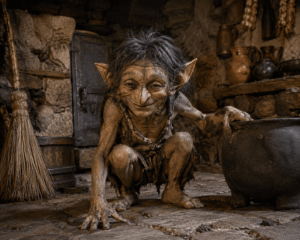
Descriptions vary from village to village, which is typical of oral folklore that’s been passed down for generations without ever being written into a single official version. The most consistent image is a small, thin man, dark-skinned, with a limp in his right leg and a hole through the palm of his left hand. He’s usually dressed in red, sometimes with a pointed red cap, and occasionally described with small horns or long, spindly legs.
The hole in the hand is one of the more distinctive details, and it shows up again and again in the older stories. Some versions of the tale say it’s how you can trick a trasno, since anything you hand him just falls straight through.
What he actually does
The trasno isn’t a dangerous figure. He’s a domestic troublemaker, not a threat. The mischief tends to be small and specific: hiding tools or keys, tangling the reins or manes of animals in the stable overnight, spilling flour, moving furniture a few inches while everyone sleeps, or making noises in empty rooms. It’s the kind of folklore that explains the ordinary small frustrations of rural household life, the missing object, the unexplained creak, the sense that something in the house has a mind of its own.
In some tellings, a trasno can actually be useful. If you manage to “tame” him, often by leaving out food or by some trick involving the hole in his hand, he’ll do chores around the house and farm instead of causing trouble. The catch is that he stays bound to the house only until someone accidentally, or deliberately, gives him an item of clothing. Once he has clothes of his own, he considers his obligation finished and leaves for good.
Where he fits in the wider mythology
The trasno belongs to the same broad Celtic-influenced folklore layer as meigas and the lobishome, the older, pre-Christian layer of belief that Christianity in Galicia never fully replaced, just absorbed and grew around. He’s not evil in the way a meiga might be feared, and he’s not tied to death the way the Santa Compaña is. He’s closer to a cultural shorthand for domestic disorder, a way of explaining that no matter how carefully a household is run, some things will always go slightly wrong.
The same figure, under slightly different names, shows up right across the north of the Iberian Peninsula. In Asturias he’s the trasgu, in Cantabria the trasgo, and the name and the core idea travelled into northern Portugal as well, where trasno is used too. It’s a good example of how Galician folklore doesn’t exist in isolation. It shares deep roots with its neighbouring regions, shaped by the same Celtic substrate and the same rural, isolated village life that kept these oral traditions alive long after they’d faded elsewhere.
Why these stories stuck around
It’s worth remembering that these weren’t just bedtime stories. In the kind of scattered, isolated villages that make up so much of rural Galicia, a figure like the trasno gave people a shared language for the small, unexplainable things that happen in any old house or working farm. It’s a gentler counterpart to the darker end of Galician folklore, meigas, Santa Compaña, the more frightening night-time warnings, and a reminder that not everything in the old stories was meant to scare. Some of it was just meant to explain, with a bit of humour, why the tools never seem to stay where you left them.