
The Dark History of Galicia’s Meigas: The Witch Trials
The meiga is now a proud symbol of Galician culture, but behind the modern festivals and folklore lies a real history of accusation, trial, and punishment. The story is stranger, and in some ways gentler, than the popular image of a “witch hunt” suggests.
Where the Word “Meiga” Actually Comes From
The word meiga, as we use it today to mean a Galician witch, is younger than most people assume. It only starts appearing in documents from the 1610s, in the specific sense of a malevolent witch who could enmeigar, or cast harm on people and animals. Before that, the Inquisition’s records speak of hechiceros and hechiceras, healers and diviners rather than devil worshippers.
The timing is not a coincidence. The word hardens into its darker meaning just two years after the infamous witch trials of Zugarramurdi in the Basque Country in 1610, one of Spain’s largest witch panics. Galicia’s own idea of the witch absorbed a lot of imagery from that Basque scare: night flights, secret gatherings, a hierarchy among the witches, and a pact with the devil.
The Tribunal of Santiago de Compostela
Galicia’s branch of the Spanish Inquisition, based in Santiago de Compostela, was active from the mid-1500s until the institution was finally abolished in the country in 1834. Its earliest recorded cases, from 1565, targeted a tailor and a blind man, both accused of invoking demons and telling people about hidden or future events.
An earlier warning sign came from the church itself. A synod held in Ourense in 1543 and 1544 already excommunicated anyone who consulted diviners or healers, or who stole consecrated oil to mix into spells.
Surprisingly Few Executions
Here is the part that tends to surprise people. Over nearly three centuries, the Inquisition in Galicia condemned only one accused meiga to death. Her name was María Rodríguez, a Portuguese woman from Ponte de Limia, burned alive in Santiago de Compostela on 30 November 1579 after confessing, under torture, to a pact and carnal relations with the devil.
Only one other case came close to that severity: Francisca do Río, from Santa Martiño do Morrazo, sentenced to life imprisonment in 1692 for the same kind of accusation. Most others accused of witchcraft, such as Ana de Castro, received public flogging and banishment rather than death.
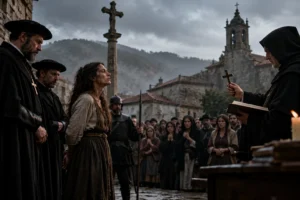
The usual sentence looked like this: a walk of public shame through the streets of Santiago wearing a tall conical hat known as a coroza, a rope around the neck knotted to mark out the number of lashes (often around two hundred), and banishment from the area for two to four years. Grim by any modern standard, but far short of the mass burnings associated with witch panics elsewhere in Europe.
Why the Inquisition Barely Bothered
One explanation researchers point to is money. The Inquisition largely funded itself by confiscating the property of the accused, and most women denounced as meigas in Galicia were poor. There was little financial incentive to pursue them compared to wealthier targets, such as conversos accused of secretly practising Judaism, who made up a much larger share of the tribunal’s actual caseload. Cases like that of Inés Díaz of Monforte, investigated simply for wearing clean blouses on Saturday nights, or Isabel de Acosta, whose bones were exhumed and burned posthumously in Santiago’s Praza da Quintana, were, in numerical terms, far more typical of the tribunal’s work than any witch trial.
When Secular Courts Were Harsher Than the Church
Ironically, ordinary secular justice in Galicia was sometimes crueller toward accused meigas than the Inquisition itself. Around 1600 to 1611, a case broke out on the Costa da Morte involving a woman known as the meiga Beatriz and five associates in Carantoña. The local secular judge tortured the accused so severely that the Inquisition’s own representatives intervened, worried that events were spiralling into something worse than what had happened in Navarre during the Zugarramurdi affair. The suspects were moved into the Inquisition’s custody, which by comparison offered them more protection, not less.
From Persecution to Pride
What makes the Galician case genuinely unusual is the ending. Elsewhere, communities associated with witch panics have spent centuries trying to live the reputation down. Galicia did the opposite. Festivals such as A Coruña’s Noite de San Xoán and Ribadavia’s Noite Meiga have taken the same figure once dragged through the streets of Santiago in a coroza and turned her into a proud symbol of regional identity, one that now draws tourists rather than accusations.