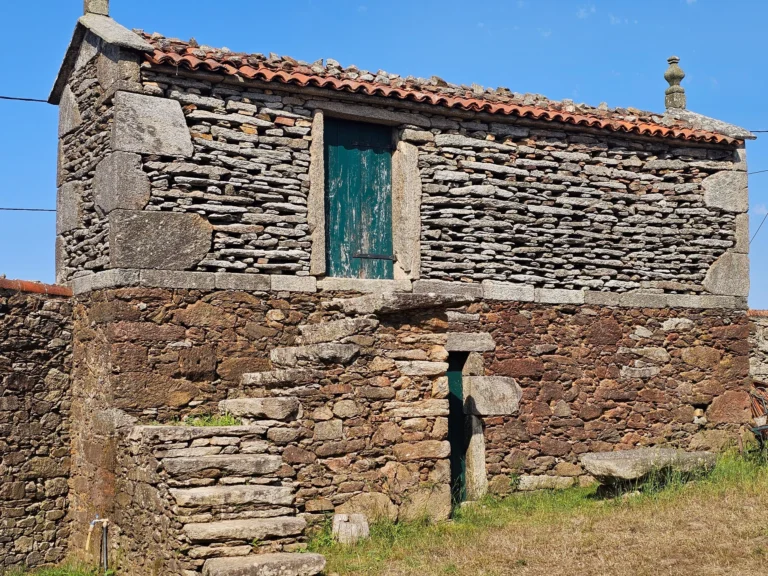

Drive far enough into Galicia’s interior and the road eventually narrows, the signal drops, and the villages start to feel less like places people live and more like places people used to live. A roofless stone house here, a collapsed hórreo there, a chapel with no congregation left to fill it. This is one of the quieter, stranger sides of Galicia: a region dotted with thousands of villages that nature is slowly taking back.
A Landscape of Empty Villages
The scale of this is larger than most visitors expect. Spain is estimated to have around 3,000 fully abandoned villages, with another 2,000 or so home to just a single remaining resident. The overwhelming majority of these sit in what Spaniards call “green Spain,” the wetter, hillier north, and Galicia and neighboring Asturias account for the largest share.
Within Galicia itself, the north of the provinces of Lugo and A Coruña carries the heaviest concentration, with roughly 1,500 abandoned villages in Lugo and around 2,000 in A Coruña. And the number is still climbing. Over a recent two-year stretch, counts rose from 795 to 838 in Lugo, 641 to 676 in A Coruña, 258 to 321 in Pontevedra, and 171 to 193 in Ourense, with Pontevedra posting the fastest growth at roughly 24 percent.
Why the Villages Emptied Out
The core story is a familiar one across rural Europe: young people left for the cities or emigrated abroad, and farming on Galicia’s steep, fragmented hillsides stopped making economic sense. Over a generation or two, entire hamlets simply ran out of people.
But a few villages have a more dramatic backstory. Some disappeared not gradually but suddenly, submerged under reservoirs built for hydroelectric power in the twentieth century. The Santo Estevo reservoir in Pantón, part of the Ribeira Sacra, is one such case, and the Alto Lindoso reservoir near Lobios, close to the Portuguese border, is another. Where a village once stood, there is now simply water.
The Unusual Real Estate Market Behind Them
What makes Galicia’s abandoned villages more than a historical curiosity is the small but active property market built around them. Specialized agencies, most notably one called Aldeas Abandonadas, deal exclusively in selling abandoned villages, empty hamlets, manor houses, farms, and even the occasional small palace, often at prices that would be unthinkable elsewhere in Western Europe.
Most of these properties are in a ruinous state and suit buyers willing to take on significant renovation work rather than move in straight away. Prices vary enormously, from around 30,000 euros for a handful of tumbledown houses to well over a million for larger estates.
The buyers themselves have shifted over time. Agents in this niche report that international interest, once dominated by Russian, Belgian, Argentinian, and Finnish buyers, now increasingly comes from Americans, Dutch, Swiss, and German buyers. At the same time, Spanish buyers remain a steady presence, often descendants of a village’s original families looking to reconnect with their roots or create a rural second home.
Finding and Visiting Them
For travelers curious to see one of these villages rather than buy one, a project called Proxecto Ecatur has spent years cataloguing abandoned villages across Galicia, recording details like the number of remaining buildings, their state of conservation, and whether basic services like electricity or road access still exist. It is a useful starting point for anyone who wants to go beyond the general phenomenon and look at specific, documented locations.
A word of caution: these are not tourist attractions with marked paths and visitor centers. Many sit on private land, buildings can be structurally unsafe, and access roads are sometimes unpaved or unmarked. Anyone visiting should stick to public viewpoints where possible and avoid entering unstable structures.
A Landscape in Slow Transition
There is something quietly moving about Galicia’s abandoned villages. They are not ruins in the ancient sense, not old enough to be treated as heritage sites, but not recent enough to still hold a living community either. They sit in between, slowly being absorbed back into the forest and gorse that surrounds them.
For every village left to fall further into ruin, though, another is being bought, however slowly, by someone with the patience to bring it back to life. In that sense, Galicia’s ghost villages are not entirely a story of decline. They are also, for a small number of them, a story of second chances.