Some places have local legends that stay tucked away in books. Galicia has one that seems to follow you around, in the shape of the road signs pointing to remote chapels, in the way older houses are built with certain doors facing certain directions, and in the sheer number of times it comes up the moment you start reading about the region‘s folklore. It’s called the Santa Compaña, and once you learn about it, it’s hard to walk a dark rural road here without thinking of it, even if, like us, you’ve never heard the story told firsthand by anyone in your own village.
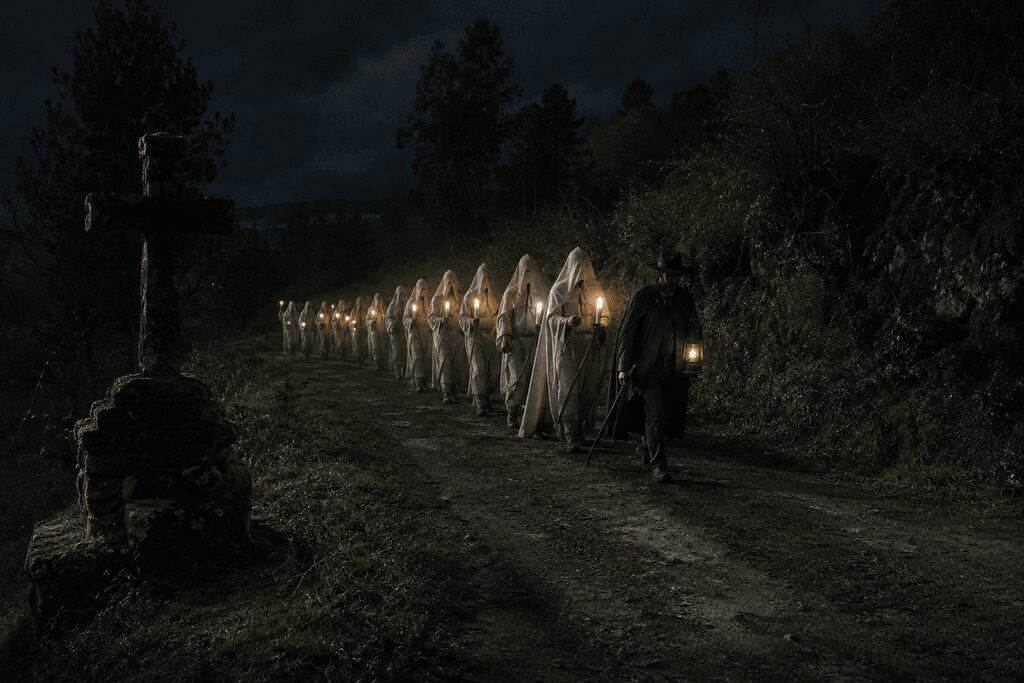
The legend describes a procession of wandering souls that moves silently through empty roads and crossroads at night, dressed in white burial shrouds, each carrying a lit candle. At the front walks a living person, someone unlucky enough to have been chosen to lead the procession, condemned to the role until they manage to pass it on to someone else they encounter along the way. The stories differ on the details, but the core is always the same: a line of the dead, moving with purpose through the dark, led by someone who wishes desperately they weren’t there.
Galician folklore is specific about how you’re supposed to recognize the Santa Compaña if you cross its path. A candle flame that doesn’t flicker despite the wind. A strange, total silence that falls over everything, as if the night itself is holding its breath. A faint rustling with no clear source. And the advice for what to do if you suspect you’ve encountered it is equally specific: draw a cross on the ground, form a circle of candles around yourself, and above all, never make eye contact with the procession or accept the candle if it’s offered to you, since accepting it is said to mean taking the leader’s place.
Where a story like this comes from is rarely a single, tidy answer, and the Santa Compaña is no exception. Part of its roots likely trace back to pre-Christian, Celtic-influenced beliefs about the dead and the thin boundary between the living world and the next, the same broader cultural undercurrent that shows up in Galicia’s wider Celtic identity, something we’ve explored separately when writing about whether Galicia can really be considered Celtic Spain. Later, Catholic ideas about purgatory and penance were layered on top, turning the wandering souls into something closer to a warning about unfinished spiritual business, souls unable to rest until they’ve completed some kind of penance.
Why this particular legend took such firm hold in Galicia specifically, rather than fading the way so much regional folklore does elsewhere, probably has as much to do with geography as with any deliberate storytelling tradition. This is a region defined by dense fog rolling in without warning, narrow paths cutting through thick forest, and rural roads that turn genuinely pitch black once the last house light disappears behind you. We notice this ourselves simply living out here, the kind of darkness and quiet that makes any unexpected sound or shifting mist feel loaded with meaning, even when you know perfectly well it’s just wind or an animal in the undergrowth. It’s easy to see how a story like the Santa Compaña would have taken root and refused to let go in a landscape built almost for the purpose.
How seriously the legend is taken today varies enormously depending on who you ask. For most younger Galicians, it firmly belongs to the realm of stories told by grandparents, closer to entertainment than genuine belief. But in more isolated rural corners, the superstition around it hasn’t entirely disappeared, and older residents in particular sometimes speak of it with a seriousness that goes beyond simple folklore. We want to be honest that we’re writing about this from research and reading rather than lived experience, since we haven’t spoken to anyone locally about it ourselves, but the fact that the legend surfaces so consistently across Galician writing, museums, and cultural references tells its own story about how deeply it’s woven into the region’s identity.
What we find most interesting isn’t really whether anyone still believes in a literal procession of the dead walking rural roads at night. It’s what a legend like this reveals about a place, how it was shaped by isolation, weather, and the particular kind of darkness that rural Galicia still has in abundance, in an age when true darkness and silence have become rare almost everywhere else. Stories like the Santa Compaña survive not because people necessarily believe them but because they capture something true about the feeling of a place, and that alone makes them worth preserving and passing on, regardless of whether you’d cross yourself at a crossroads at midnight.