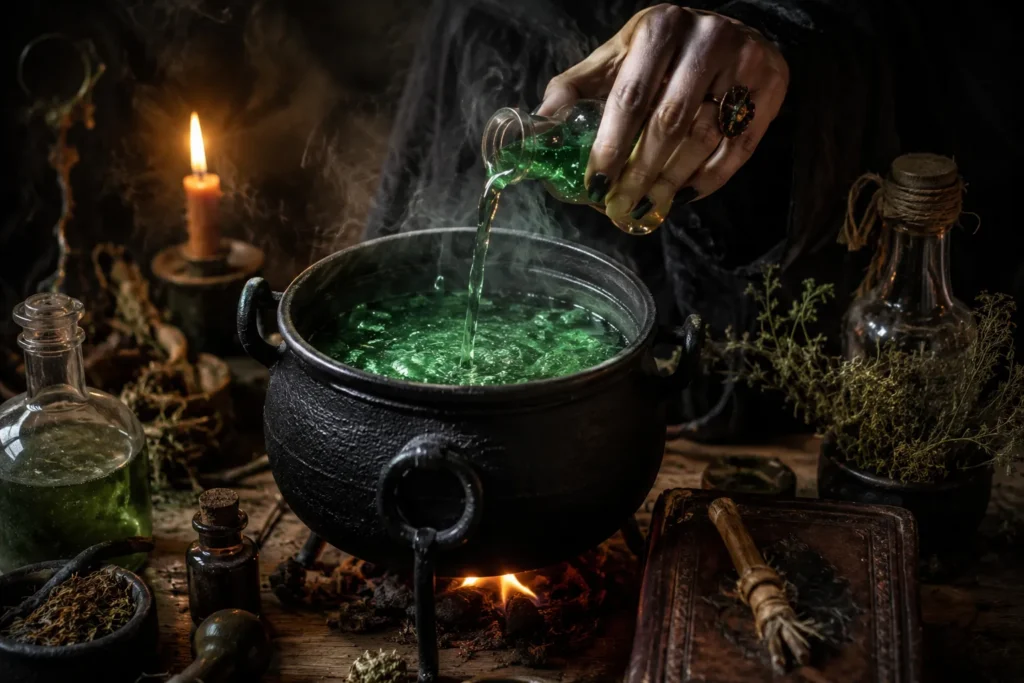
A clay pot glows with blue flame in the dark. A long wooden ladle rises and falls, trailing fire. Somewhere in the smoke, a voice recites something in Galego about owls, toads, and witches. This is queimada, and it is not just a drink. It is a ritual, and it comes straight out of the same folklore we wrote about in our piece on the meigas, Galicia’s witches. If that article introduced the belief, queimada is the tradition you can actually watch, smell, and taste.
What Queimada Actually Is
At its base, queimada is built on orujo, also called aguardiente, a strong pomace brandy distilled from the leftover grape skins after winemaking. It is Galicia’s answer to Italian grappa, and it forms the backbone of the drink. The orujo is combined with sugar, strips of lemon or orange peel, whole coffee beans, and sometimes a cinnamon stick, all mixed together in a fireproof clay pot, or in some villages, a hollowed-out pumpkin.
The mixture is then set alight. As it burns, it produces a distinctive blue flame, and the person preparing it stirs and ladles the burning liquid slowly, again and again, letting it fall back into the pot in a glowing arc. It is as much a piece of theatre as it is a drink being made.
The Conxuro: The Spell That Makes It a Ritual
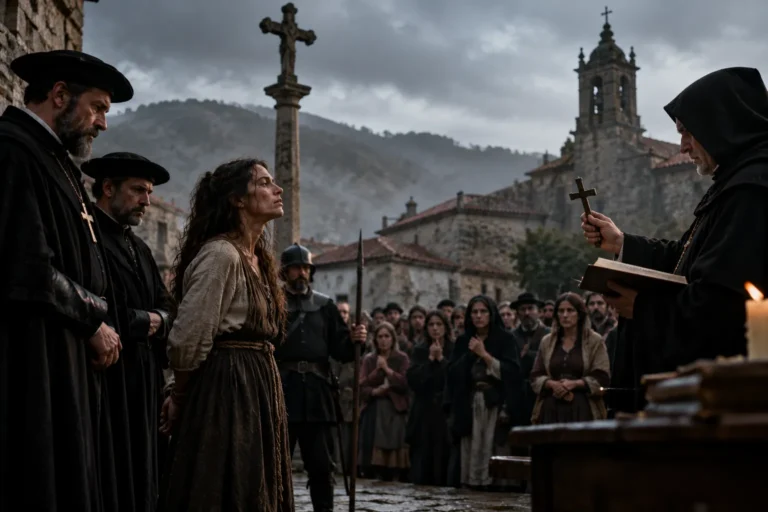
What separates queimada from simply setting alcohol on fire is the conxuro da queimada, the spell recited while the pot burns. The drink and the incantation are not separate things. Without the words, it is just flaming liquor. With them, it becomes a ritual meant to cleanse a space and the people in it, and to drive off bad luck, curses, and evil spirits before a celebration, a new year, or simply a shared evening among friends.
The conxuro is recited in Galego, and it reads like a roll call of everything Galician folklore considers unsettling: owls, toads, witches, demons, and the Santa Compaña, the ghostly procession we’ve written about before, all get named directly. A few lines, translated, give a sense of it:
Owls, screech owls, toads and witches. Demons, goblins and devils, spirits of the misty meadows.
It is not a spell borrowed from a book. It belongs to oral tradition, and versions of it differ slightly from village to village, which is part of what keeps it alive rather than fixed.
Where the Tradition Comes From
Queimada’s roots reach back into Galicia’s Celtic heritage, where fire was seen as a purifying, protective force capable of driving off harm. That same current runs through Samhain and, closer to home, through Magosto, the region’s autumn chestnut festival, where fire and the remembrance of spirits play a similar role. It is worth noting the overlap: several of Galicia’s oldest traditions circle back to the same idea, that fire, spoken words, and community together can hold something dangerous at bay.
In some tellings, the ritual is performed by a meiga herself, or by someone dressed to resemble one, which makes the link to the region’s witch folklore explicit rather than incidental. Queimada is not simply inspired by meiga beliefs. It is, in a real sense, meiga folklore in practice.
How It’s Experienced Today
Queimada is still very much alive. It shows up at family gatherings, village festivals, and increasingly along the Camino de Santiago, where pilgrims are often treated to a version of it at a hostel or restaurant, staged for visitors but genuine in its roots all the same.
The communal part matters as much as the fire itself. Once the flames are extinguished, usually smothered with a lid, the drink is served warm in small clay cups and shared around the group. Local lore attaches a bit of superstition to the drinking itself: the first sip is said to ward off evil spirits, the second to clear the mind, and the third to stir passion. It is worth treating this as folklore rather than fact, but it is exactly the kind of detail that makes queimada feel like more than a cocktail.
A Word on Safety
This is worth saying plainly: queimada involves setting high-proof alcohol on fire in an open pot, and that deserves real care. It belongs outdoors or in a clearly fireproof space, well away from anything flammable, with a lid or a damp cloth on hand to smother the flames if needed. This is not a ritual to improvise indoors on a whim.
A Tradition You Can Taste
Where As Meigas explained a belief that still lingers in daily conversation across Galicia, queimada is that same belief made tangible: something you can watch burn, listen to in Galego, and eventually sip once the flames go out. If you find yourself in Galicia during a festival season, keep an eye out for it. It is one of the more striking ways the region’s old folklore still shows up in ordinary life.