Ask someone outside Galicia what an empanada is, and they’ll usually picture something handheld, individually sized, closer to a pastry snack. Ask someone in Galicia the same question, and they’ll picture something else entirely: a large, flat, savory pie, cut into squares, served at room temperature, and treated less like street food and more like a proper dish. Both are correct. They’re just not really the same thing.
The Shape Says Everything
The most obvious difference is size and form. In most of Spain, and especially in Latin America where the word “empanada” is more globally known, the default is a small, folded, half-moon pastry, baked or fried, meant to be eaten in a few bites, often on the go. Argentina’s version is a good example of this style, and it’s the one most people picture internationally.
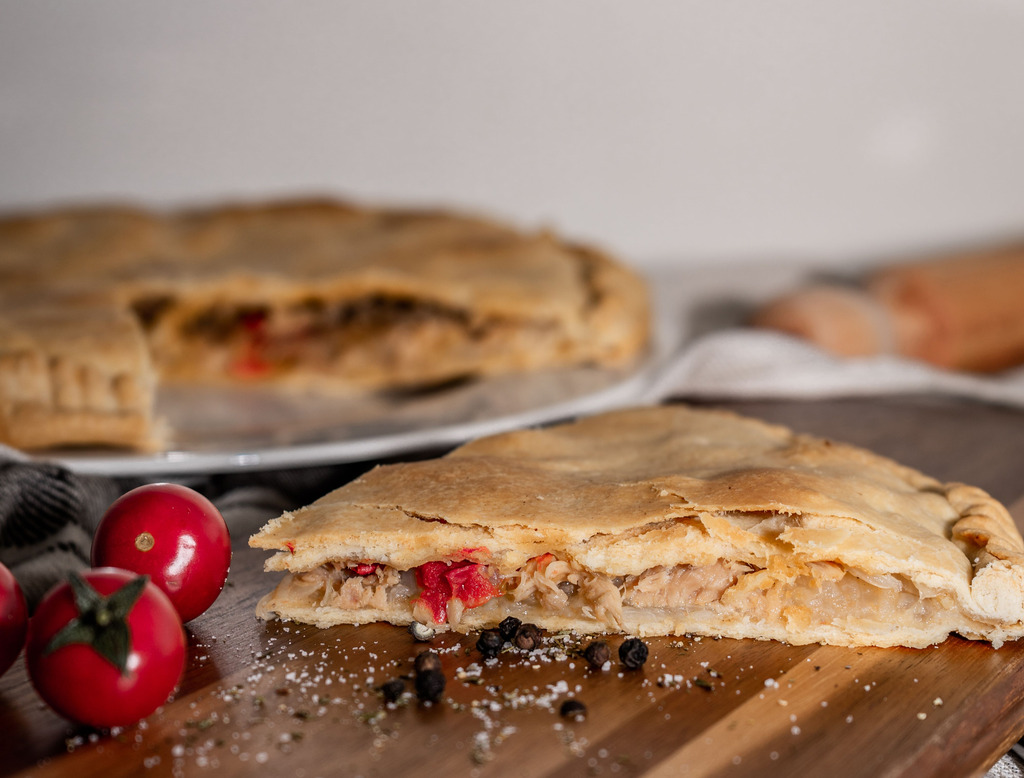
Empanada gallega is not that. It’s baked as a large, round or rectangular pie, rolled thin, filled generously, and sealed with a top layer of dough rather than folded. It gets cut into squares or wedges and served as a shared dish, often at room temperature rather than hot. You’re far more likely to see it laid out whole at a family gathering, a market stall, or a bar counter than handed to you individually wrapped.
The Filling Is a Regional Statement
Fillings vary across Spain, but Galicia’s are distinct enough to be their own category. The most classic Galician version is filled with tuna (empanada de atún) or, especially near the coast, mussels, cockles, or other seafood, reflecting the region’s relationship with the Atlantic. Inland versions lean toward pork, chorizo, or the classic combination of onion cooked down slowly with pepper and tomato, which forms the base (the sofrito) for most fillings, seafood or meat alike.
That slow-cooked onion base is arguably the real signature of empanada gallega, more than any specific filling. Galician cooks will tell you the sofrito, not the protein, is what separates a good empanada from a mediocre one. It needs time, not shortcuts.
The Dough Matters More Than You’d Think
Galician empanada dough tends to be thinner and more bread-like than the shortcrust or puff pastry used in many other Spanish and Latin American versions. There are two dough traditions within Galicia itself, roughly speaking: a bread-dough style (masa de pan), which is softer and slightly chewy, and a more traditional shortcrust-like dough (masa quebrada), which is flakier. Both are considered legitimate, and which one is “correct” is the kind of thing that can start a genuinely serious debate at a Galician dinner table.
Why Galicians Take It Seriously
Empanada in Galicia isn’t a snack food category the way it can be treated elsewhere. It shows up at festivals, family celebrations, and Sunday lunches, and it’s common for households and bakeries to have a version they’re known for. There’s a strong sense of empanada as a marker of good home cooking, not a convenience food, which is part of why the size and presentation lean toward “a dish to be shared” rather than “something to eat with one hand while walking.”
Where to Try It
If you want to taste the difference for yourself, look for empanada sold by weight or by the square at a Galician panadería or market, rather than the individually wrapped, fried versions sometimes sold as quick snacks in tourist areas elsewhere in Spain. The difference in texture and filling becomes obvious fairly quickly once you’ve had both.