On clear days, we don’t have to go looking for vultures at all. We just have to look up. From our own house in the village, we regularly watch them circling on the thermals rising off the canyons nearby, wings barely moving as they ride the warm air higher and higher. It’s one of those small, everyday wonders of living in this part of Galicia that never quite stops feeling special.
If you’re planning a trip to the Ribeira Sacra, there’s a good chance you’ll see them too, often before you even realize what you’re looking at.
Which Vultures Live in Galicia
Griffon Vulture (Buitre Leonado)
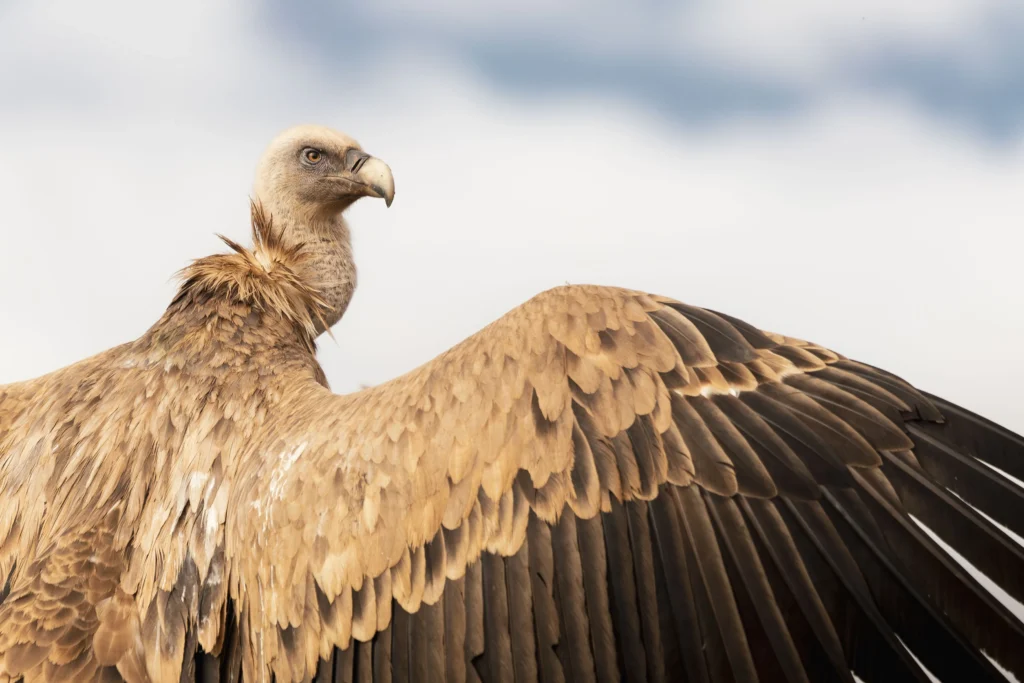
The Griffon vulture is by far the most common of Galicia’s vultures, and the one you’re almost guaranteed to spot if you spend any time near the region’s river canyons. They nest colonially on cliff faces, often in groups of dozens of pairs, and the Sil and Miño canyons of the Ribeira Sacra hold some of the healthiest colonies in Galicia. With wingspans that can reach nearly 2.8 meters, they’re unmistakable once you know what to look for: broad wings held in a shallow V, pale golden-brown plumage, and an effortless, almost lazy soaring flight.
Cinereous Vulture (Buitre Negro)
Larger and considerably rarer than the Griffon, the Cinereous vulture is more closely tied to forested areas than bare cliffs, and sightings in Galicia are a genuine treat rather than a daily occurrence. It’s the largest bird of prey in Europe by weight, dark all over, and tends to fly with a flatter wing profile than its Griffon cousins.
Egyptian Vulture (Alimoche)
Smaller, paler, and considerably more striking in appearance, the Egyptian vulture is a summer visitor to Galicia, arriving to breed before migrating back to Africa in autumn. Adults are mostly white with black flight feathers and a bare yellow face, making them easy to tell apart from the region’s other vultures once you’ve seen one.
What About the Lammergeier?
If you’ve read about the bearded vulture, or lammergeier (quebrantahuesos), and hoped to spot one here, it’s worth setting expectations early: this species doesn’t live in Galicia. Its Iberian range is centered on the Pyrenees, hundreds of kilometers away, and any large raptor you see over the Ribeira Sacra is far more likely to be a Griffon.
Best Places to See Vultures in the Ribeira Sacra
The steep canyon walls carved by the Sil and Miño rivers are exactly the kind of terrain Griffon vultures favor for nesting, which makes the Ribeira Sacra one of the more reliable places in Galicia to watch them. Miradores overlooking the Sil canyon are a good starting point, since the updrafts along the cliff edges are what draw the vultures up in the first place. If you’re already planning to visit one of the region’s canyon viewpoints for the scenery, keep your eyes on the sky as well as the water below.
Best Time of Year and Time of Day to Spot Them
Vultures rely on rising warm air to stay aloft with minimal effort, so their activity tracks the sun. Mid-morning through early afternoon, once the day has had time to heat the canyon walls, is generally when you’ll see the most movement. Warmer months tend to bring more consistent thermals and more visible activity, though Griffon vultures are resident year-round and can be spotted in any season on a clear day.
Vulture-Watching Etiquette
A few simple habits go a long way toward enjoying these birds responsibly:
- Bring binoculars rather than approaching cliff edges or nesting areas too closely
- Keep noise to a minimum near known colonies, especially during breeding season
- Avoid drone flights near nesting cliffs, as they can disturb the birds significantly
- Watch from established viewpoints rather than venturing off-trail toward nest sites