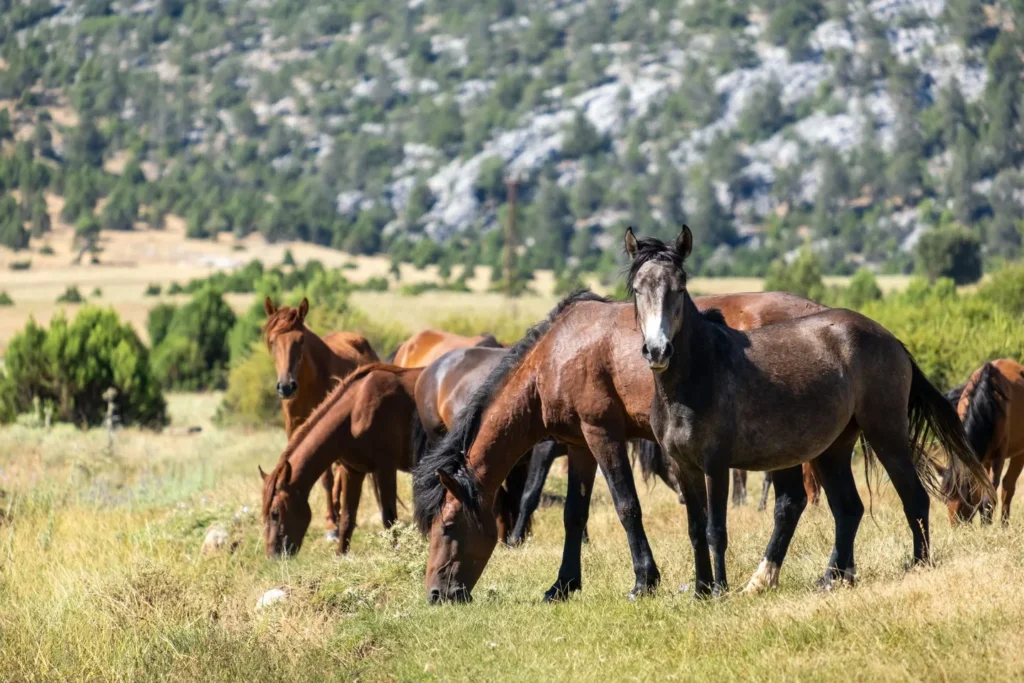
Galicia has no shortage of wildlife, but few animals feel as symbolic of the region as its free-roaming horses. You can find them on misty hillsides, beside quiet country roads and high above the Atlantic coast, usually in small groups with their heads down in the grass.
They are often called wild horses, although the reality is a little more complicated. Many belong to local communities or individual owners and live freely on common grazing land for most of the year. They are not pets, though, and they should be treated as what they are: powerful, semi-feral animals living in an open landscape.
For visitors, seeing a small herd appear through the fog is one of those genuinely memorable Galician moments. It is also a window into a rural tradition that has existed here for centuries.
Where can you see wild horses in Galicia?
The best-known areas are in the mountains of Pontevedra and along the northern coast.
Sabucedo and the hills around A Estrada
Sabucedo is the place most closely associated with Galicia’s horses. The surrounding uplands are home to herds that spend much of the year roaming freely, and the landscape itself is worth exploring: woodland, small farms, old stone walls and open hills.
A good option is the Codeseda–Sabucedo walking route, which passes through the kind of mid-mountain pasture where horses are often seen. There is never a guarantee, of course. That is part of the appeal. You are not visiting a wildlife park; you are walking through the animals’ landscape.
Serra da Capelada
For a more dramatic setting, head north to Serra da Capelada, near Cedeira and Cariño. Here, horses roam on high coastal ground above some of the most impressive cliffs in Galicia. The route toward Santo André de Teixido is particularly beautiful, especially on a clear day when the Atlantic suddenly opens up below you.
The weather changes quickly here. Bring a jacket even in summer, and do not be surprised if the horses appear out of the mist rather than in perfect sunshine.
Serra do Suído and Serra da Groba
The mountains of southern Pontevedra and the border area with Ourense are also known for free-roaming horses. Serra do Suído is quieter and more remote, while Serra da Groba, close to Baiona, combines open hills with distant views toward the coast.
These are places for slow exploration rather than ticking off a specific attraction. Drive carefully, stop only where it is safe and give yourself time to walk a little way from the road.
When is the best time to see them?
Spring and autumn are probably the most pleasant seasons. The hills are green, temperatures are comfortable and there are fewer visitors around. Early morning or late afternoon can be especially rewarding, when the light is softer and the animals are often more active.
Summer is also a good time, particularly in the higher mountains where the breeze offers relief from the heat. It is the season when the famous rapas das bestas take place, but it is worth remembering that the festival is only one small part of the horses’ year-round life.
How to watch horses responsibly
The basic rule is simple: admire them without changing their behaviour.
Keep a respectful distance, particularly if there are foals nearby. Never try to feed a horse, touch it or stand in its path for a photograph. A horse that looks relaxed can still react quickly if it feels cornered, startled or protective of its young.
If you are driving, slow down well before you reach the animals. Horses sometimes stand in the road or move between grazing areas without warning. Do not sound your horn to make them move; wait patiently and let them choose where to go.
For photographs, a longer lens is better than getting closer. The most convincing images are often the ones that show the animals as part of the landscape: a herd on a ridge, a single horse beside an old stone wall, or shapes disappearing into low cloud.
What is Rapa das Bestas?
Every summer, several Galician communities gather their free-roaming horses for a tradition known as Rapa das Bestas, literally “the shearing of the beasts.” The most famous takes place in Sabucedo, usually during the first weekend of July.
The horses are brought down from the hills into an enclosure called a curro. Their manes and tails are trimmed, and young animals may be identified and checked. For local communities, this is not simply a show for visitors. It is tied to the management of the herds, shared grazing land and a long-standing sense of local identity.
The event in Sabucedo is especially well known because the aloitadores handle the horses without ropes or sticks, using their bodies and teamwork to control the animals. It is intense to watch: loud, physical and undeniably uncomfortable at times.
That discomfort is worth acknowledging. Some visitors see the tradition as an important part of Galicia’s rural heritage; others have serious concerns about animal welfare. Both reactions are understandable. If you go, it is better to arrive informed and to see it as a living, complicated local tradition, not as a simple spectacle.
For many people, seeing the horses freely in the mountains outside festival time is a calmer and more meaningful experience.
A different side of Galicia
The wild horses of Galicia are a reminder that this region is not only about beaches, seafood and the Camino de Santiago. There is a wilder interior too: old grazing land, rain-soaked hills and communities whose relationship with the landscape has been shaped over generations.
You may see a herd while driving to a viewpoint, walking a rural trail or taking the long road toward the coast. There is no need to chase the experience. In Galicia, the best wildlife moments often happen when you slow down enough to notice what is already there.