
What Are Castros? Celtic Hillforts Explained
For the first few weeks of driving around here, we kept passing the same sign: Castro. Along a winding road into a village, at a turn-off in the middle of nowhere, next to a field. Castro here, Castro there. We genuinely assumed it was just a wildly popular place name, some Galician equivalent of “Newtown” or “Main Street.” It wasn’t until we’d passed the third or fourth Castro de [something] in completely different parts of the region that it started to nag at us: there can’t really be that many villages that happen to share the exact same name. So we looked it up.
That’s when it clicked. A castro isn’t a place name at all. It’s a type of place: a fortified hilltop settlement built by the Celtic peoples who lived here centuries before the Romans arrived. The word comes from the Latin castrum, meaning “fort” or “fortified place,” and it’s used across northwestern Spain for this kind of archaeological site. That’s why the word shows up everywhere: not because there’s one location called that, but because there are hundreds of these settlements scattered across Galicia, each with its own name tacked on after it.
Who built these places?
The people who built these hillforts are known as the Gallaeci, a Celtic people who occupied the territory that is now Galicia and northern Portugal. Their way of life, in small independent communities perched on hilltops, is what archaeologists call the Castro Culture. It emerged toward the end of the Bronze Age, around the 9th century BCE, and persisted until the Romans eventually absorbed the region, roughly around the turn of the millennium. Some castros, in fact, stayed inhabited for centuries after that, in a few cases well into the early medieval period.
The settlements themselves vary enormously in size. The smaller ones, more common in the north of Galicia, covered less than a hectare: a handful of round stone houses behind a defensive wall. The larger examples, often called oppida, could sprawl across ten hectares or more and functioned almost like small towns. What they all share is the location: on top of a hill or ridge, overlooking the surrounding land. That makes sense once you remember the original purpose was defense.
Why build on a hill?
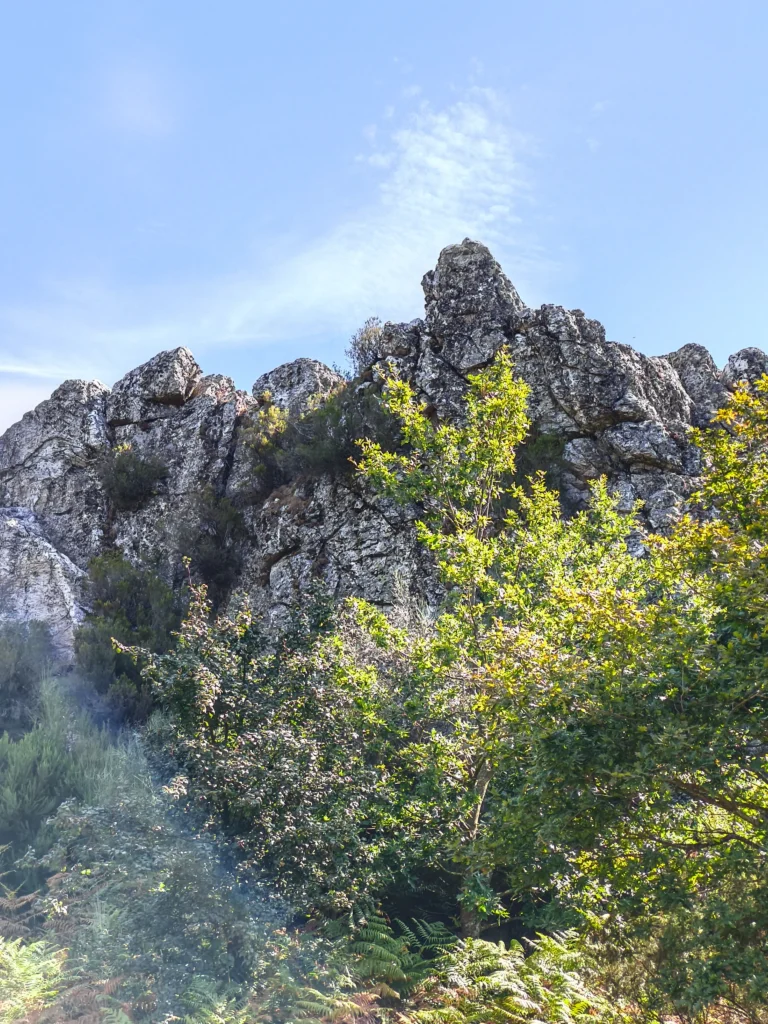
Visit a few of these sites and it becomes obvious why. The Celtic peoples of Galicia worked extensively in stone, and wherever they found granite-rich hills, they settled. The round stone houses, often partially intact when excavated, don’t follow straight streets or a tidy grid the way later Roman towns do. It feels more organic, grown rather than planned. And the hilltop position offered not just a clear view of approaching danger, but also some distance from the river valleys, which turn damp and foggy in winter.
Castros nearby
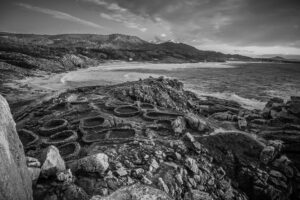
The Ribeira Sacra and the wider region are dotted with dozens of these sites, some well-preserved and signposted, others little more than a few overgrown foundations in a field. Better-known examples elsewhere in Galicia include Castro de Baroña on the coast, dramatically perched on a small peninsula, and Castro de Viladonga near Lugo, where an archaeological museum sits right next to the site so you can see the finds and context together. San Cibrán de Lás near Ourense is also worth a visit: one of the larger oppida, with remains suggesting it was once a fairly substantial community.
Many of the smaller castros in our own area are less documented or signposted, but that’s exactly what makes stumbling across them interesting: no tour buses, no ticket booth, just a few stretches of stone wall on a hill where, if you look closely, you can still trace the outline of round houses.
A sign that says more than you’d think
What stays with us now is how matter-of-factly this history sits in the landscape here. Not behind glass in a museum, but right along the road, marked with a plain brown sign that’s easy to miss if you don’t know what you’re looking for. Since we figured out what we were actually seeing, we’ve doubled back a few times for castro signs we’d driven past without a second thought. And every time, it’s been worth the stop: a piece of Celtic Galicia, a few thousand years old, sitting quietly next to the road you happened to be driving down.
So if you ever find yourself driving around here and spot a sign that just says “Castro,” know that it’s not a village. It’s an invitation to stop for two minutes and look at what stood there, long before any road ever ran past it.