

Heating a rural Galician home
When we moved to a village in the Ribeira Sacra, one of the first things we had to figure out was how the house would be heated. There is no central heating system here, and that turned out not to be unusual at all. Most rural homes in this part of Galicia rely on a wood stove, often combined with air conditioning units for the rooms the stove doesn’t reach. Coming from the Netherlands, where a thermostat controls every room from a single boiler, this took some getting used to.
The reason wood is still the standard has to do with how these houses were built. Older Galician houses tend to have thick stone walls and little to no insulation in the way we were used to. They were built to stay cool in summer, not to retain heat efficiently in winter. A wood stove, usually placed in the main living area, heats that room well, but doesn’t really carry warmth through the rest of the house. That’s simply how these buildings work, and most people who live in them plan around it rather than try to change it.
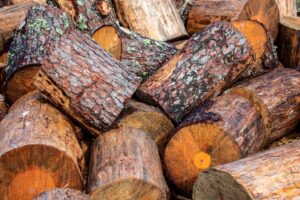
Buying firewood here works differently than we expected. There’s no standard bag or pallet at a hardware store. Instead, you order from a local supplier, and it gets delivered by truck as a “carro de leña,” loosely translated as a cart or load of wood. There’s no fixed unit behind this term: what counts as one carro varies by region and by supplier, so the only reliable way to know what you’re getting is to ask the specific supplier beforehand, ideally with a rough volume or weight in mind. Prices vary the same way, by supplier and by region, so it’s worth asking a few people locally rather than assuming one number applies everywhere. Most people order before the cold months start, since suppliers get busier as autumn turns into winter and waiting too long can mean a delay.
Whether the wood is dry (seco) or fresh (verde) matters more than it might seem. Fresh wood still holds moisture, burns less efficiently, produces more smoke, and is usually cheaper for that reason. Dry wood has been left to season for months, burns hotter and cleaner, and costs more. Suppliers will tell you which one you’re buying, but it’s worth asking directly, since the difference shows up immediately once you start a fire: dry wood lights more easily and burns steadily, while fresh wood is harder to get going and burns unevenly.
For the rooms the wood stove doesn’t heat, air conditioning units with a heating function are the common solution here, more so than in the Netherlands, where air conditioning is mostly associated with cooling. In Spain, reversible units that both cool in summer and heat in winter are standard in many homes, including ours. We use them mainly in bedrooms and other rooms further from the stove, where running a fire all day wouldn’t make sense. It’s a different approach than central heating, room by room rather than whole-house, but it works for how these homes are laid out.
A few practical things became clear once we settled into this routine. Wood needs to be stored somewhere dry and ventilated, not stacked against a damp wall, or it won’t stay usable. How much you need for a winter depends heavily on how cold it gets where you are and how much of the house you’re heating with the stove versus air conditioning, so it’s not something we’d put a fixed number on. What we noticed most, coming from a country where heating is centralized and largely invisible, is how much more hands-on this system is: you plan ahead, you order in time, and you’re aware of how much wood you have left in a way you never are with a gas boiler.
It’s not a replacement for the kind of heating most Dutch homes have, and it asks for more planning than turning up a thermostat. But once you’re used to it, it’s a system that works fine for these houses, and it’s simply how heating is done in rural Galicia.