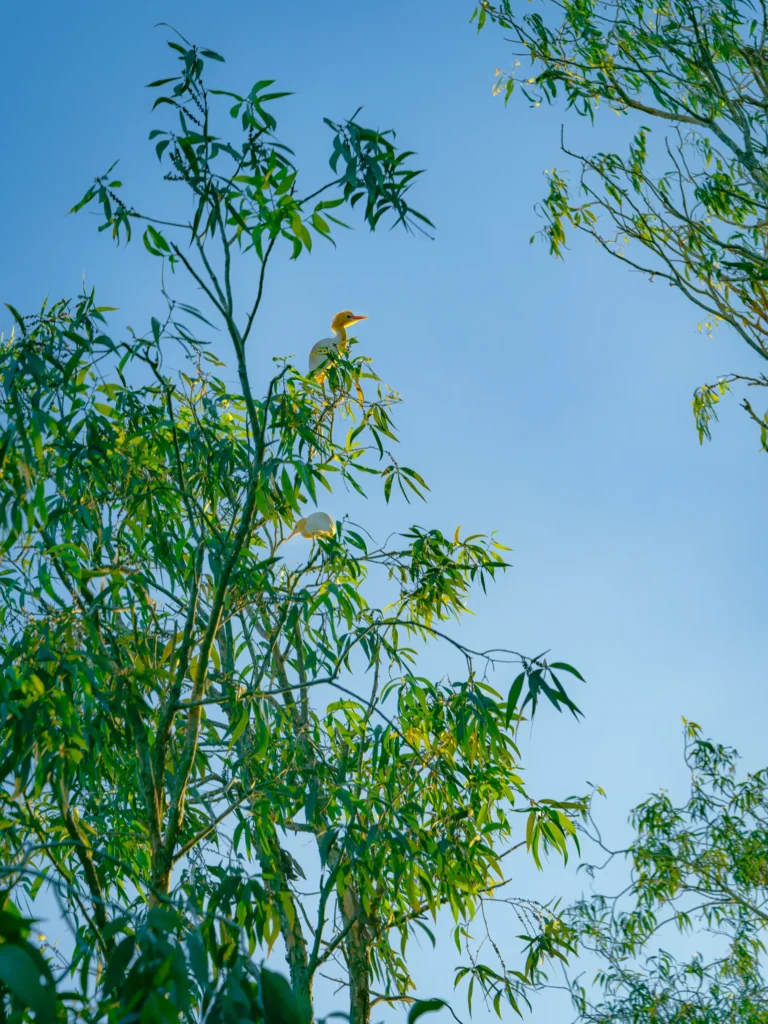
Drive through parts of Galicia, particularly near the Atlantic coast, and you will notice large areas of eucalyptus trees. Their tall, straight trunks and long leaves have become a familiar feature of the landscape. But eucalyptus is not native to Galicia. So why is it everywhere?
The short answer is forestry. Eucalyptus grows quickly in suitable conditions and supplies timber for the pulp and paper industry. Its expansion has also raised questions about biodiversity, land use and wildfire management.
Where did eucalyptus in Galicia come from?
Eucalyptus originates in Australia. It was introduced to Galicia during the nineteenth century, initially on a relatively small scale. A popular story credits the Galician missionary Rosendo Salvado with sending seeds from Australia in 1846. Historical records also document the importation of Eucalyptus globulus seeds for acclimatisation trials in 1868.
The trees did not immediately take over the countryside. Their large-scale expansion came later, as commercial forestry developed and demand for fast-growing timber increased.
Why was eucalyptus planted so widely?
For landowners, eucalyptus can be an attractive commercial crop. In suitable locations, it grows faster than many traditional timber species and can be harvested on relatively short rotations. Wood from eucalyptus is used particularly in pulp production.
Galicia also has a complex pattern of small, privately owned forest plots. Planting trees on land that is no longer farmed can provide a use for property that might otherwise be left unmanaged. This helps explain why plantations are often scattered among fields, villages and native woodland rather than forming one continuous forest.
How much eucalyptus is there in Galicia?
According to preliminary results from Galicia’s continuous forest inventory published by the Xunta in 2023, the region had around 409,000 hectares of eucalyptus plantations, compared with roughly 422,000 hectares of conifer plantations and nearly 620,000 hectares of predominantly deciduous broadleaf woodland. These figures refer to that inventory release, not a current-year measurement.
Eucalyptus is especially noticeable in some coastal and lower-altitude areas. Two important species are Eucalyptus globulus, which favours milder conditions, and Eucalyptus nitens, which tolerates colder conditions and is also planted farther inland.
Why is eucalyptus controversial?
The debate is not simply about whether a tree is good or bad. It is about where eucalyptus is planted, what habitats it replaces and how plantations are managed.
Biodiversity: Native oak and other mixed woodlands generally support different—and often richer—communities of plants and animals than intensively managed eucalyptus stands. Research in north-west Spain has identified changes in bird and plant communities associated with eucalyptus plantations.
Soil and water: Eucalyptus can affect soil conditions and water use, but the size of the impact depends on local climate, soils, previous land cover and management. Scientific reviews caution against treating every plantation and site as identical.
Landscape: Large areas of single-species plantations can reduce the variety of habitats in a region and fragment remaining native woodland. On the other hand, forestry provides income to landowners and supports businesses that depend on timber.
Does eucalyptus make wildfires worse?
Eucalyptus contains flammable oils, and dry leaves, bark and other fuel can contribute to fire behaviour. But wildfire risk cannot be explained by tree species alone. Weather, drought, wind, accumulated vegetation, the arrangement of plantations and forest management are all important.
A poorly maintained plantation near homes may present different risks from a well-managed stand. Galicia’s wildfire problem also involves land abandonment and the broader condition of the rural landscape. For more context, read What Wildfires Do to Galician Nature.
What is being done about eucalyptus expansion?
Galicia’s forestry planning has included measures intended to limit further eucalyptus expansion and improve the management of existing stands. The regional forest plan for 2021–2040 emphasises maintaining or reducing the area occupied by eucalyptus rather than allowing unrestricted growth.
There are also local initiatives to remove eucalyptus from selected sites and restore native woodland. These efforts are part of a wider discussion about how Galicia can balance forestry jobs, private property, fire prevention and nature conservation.
What trees are native to Galicia?
Galicia’s native and long-established woodlands include oak, birch and other broadleaf species, while chestnut has an especially important place in the region’s landscape and culture. You can still find very different types of woodland across Galicia, from riverside forests to mountain slopes and old oak groves.
For visitors, the distinction is often easy to see: a eucalyptus plantation usually has more uniform trunks and a more regular structure, while a mixed woodland tends to contain trees of different ages, shapes and species.
So why are there so many eucalyptus trees?
Because they became an economically useful forestry crop, not because they were part of Galicia’s original forests. Their rapid growth and the region’s landownership patterns helped plantations spread over many decades.
Today, eucalyptus is both an important source of timber and a subject of environmental debate. Understanding that balance gives a more accurate picture of the Galician landscape than either praising or blaming the trees alone.