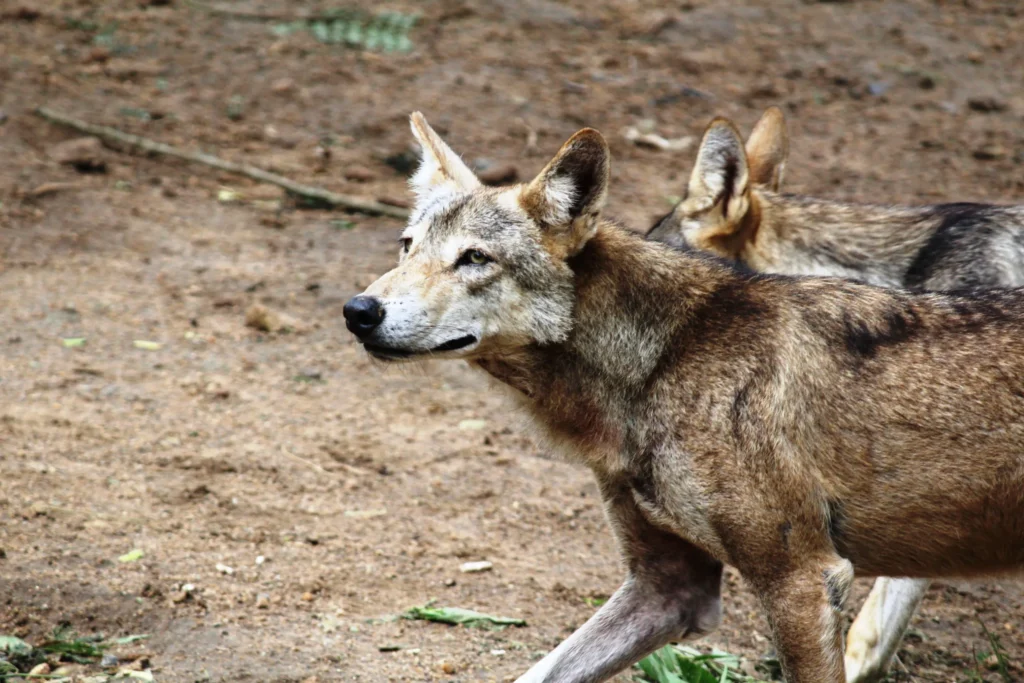
Yes, wolves live in Galicia. The Iberian wolf (Canis lupus signatus) is one of the region’s most fascinating wild animals, although most visitors will never see one. Wolves are widespread across Galicia, including landscapes that are far from untouched wilderness.
Here is what we know about where wolves live, what they eat, how likely you are to encounter one and why their presence remains controversial.
Are there wolves in Galicia?
Yes. Galicia is one of the main strongholds of the Iberian wolf in Spain. According to Spain’s national wolf census covering 2021–2024, Galicia recorded 93 wolf packs: 83 entirely within the region and 10 shared with neighbouring territories. A pack count is not the same as a count of individual wolves.
The Xunta de Galicia reports that wolf presence extends across more than 90% of the region. This does not mean wolves are equally common everywhere or that they are easy to spot.
Where do wolves live in Galicia?
Wolves occur in much of Galicia, from inland hills and woodland to mixed landscapes containing farms, villages and roads. They are not restricted to isolated mountain areas. The Galician population is connected to wolf populations in Asturias, Castilla y León and northern Portugal.
Suitable habitat provides cover and access to food. Dense vegetation, scrubland and woodland can help wolves avoid people. The exact location of packs changes over time, so broad regional information is more useful than trying to track down a particular den or breeding site.
Why are wolves so difficult to see?
Wolves generally avoid close contact with people. Even in areas where packs are established, sightings are unusual. They may be active at night or at quieter times of day, and they use vegetation and terrain for cover.
A 2026 study by researchers including the University of A Coruña and the Doñana Biological Station (CSIC) tracked 26 wolves in Galicia. It found that human activity strongly influenced their movements: wolves in more human-dominated landscapes tended to restrict how far they travelled.
For visitors, this means a walk through wolf country is very unlikely to produce a sighting. Seeing tracks or other signs is more realistic, although identifying them reliably requires experience.
What do wolves eat?
Wolves are adaptable predators. Their natural prey includes wild boar and roe deer, and they may also scavenge. In some areas they attack domestic livestock, particularly animals that are not adequately protected. Their diet varies depending on what is available locally.
Wolves are part of Galicia’s wider ecosystem, but their presence can create real costs for farmers. Both facts matter when discussing the species.
Are wolves dangerous to people?
Wild wolves generally keep their distance from humans. An encounter is unlikely, but any large wild animal should be treated with respect. Do not approach, feed or attempt to photograph a wolf at close range. Keep dogs under control and give the animal a clear route to leave.
If you unexpectedly see a wolf nearby, stay calm, avoid running towards it and slowly create distance. Never approach pups or a den.
Wolves and livestock: why is there a conflict?
For livestock farmers, wolf attacks can mean injured or dead animals, financial losses and additional work. Conservation groups emphasise the ecological role of predators, while farming organisations often argue that prevention and compensation need to be practical and reliable.
The Xunta reported an average of 2,019 wolf-attack notifications annually during 2024–2025. These are reported incidents, not a count of wolves or a guarantee that every report was confirmed as wolf predation.
Galicia operates compensation and prevention schemes. The 2026 prevention programme includes support for livestock guardian dogs and electric fencing. The effectiveness of individual measures depends on the type of livestock and the circumstances of each farm.
Are Iberian wolves protected in Galicia?
Wolf protection and management rules have changed several times in recent years and remain politically and legally contested. Spain’s 2025 legislative changes altered the national framework for wolf populations north of the River Duero, while regional management rules and European conservation obligations continue to matter.
For that reason, it is better to consult current official regulations rather than assume that wolves are either fully protected in every circumstance or freely hunted. The Xunta’s wolf information pages and Spain’s environment ministry provide the latest official guidance.
Can you go wolf watching in Galicia?
It is possible to visit landscapes where wolves live, but seeing one in the wild should never be expected. Ethical wildlife watching means keeping a respectful distance, avoiding breeding sites, not using bait and following local access rules. Never publish the precise location of a den.
If your main interest is observing wildlife, Galicia offers many more readily visible species. Our Wildlife in Galicia guide introduces the region’s animals. You can also read about bears in Galicia, vultures and wild horses.
Wolves are part of modern Galicia
The Iberian wolf is not just an animal from old legends. It survives in a region where people, livestock and wildlife share the same landscape. Understanding wolves means recognising both their ecological importance and the challenges of living alongside them.
Galicia’s wolf population is substantial by Spanish standards, but a healthy future for the species depends on habitat, management and workable solutions for rural communities.
Sources and further reading
- Spain’s Ministry for Ecological Transition — national wolf census 2021–2024
- Xunta de Galicia — Infolobo Galicia, census and management documents
- CSIC — research on wolf movements in human-dominated Galician landscapes (2026)
- Xunta de Galicia — wolf population and livestock conflict figures (2026)
- Xunta de Galicia — 2026 prevention support for livestock farms