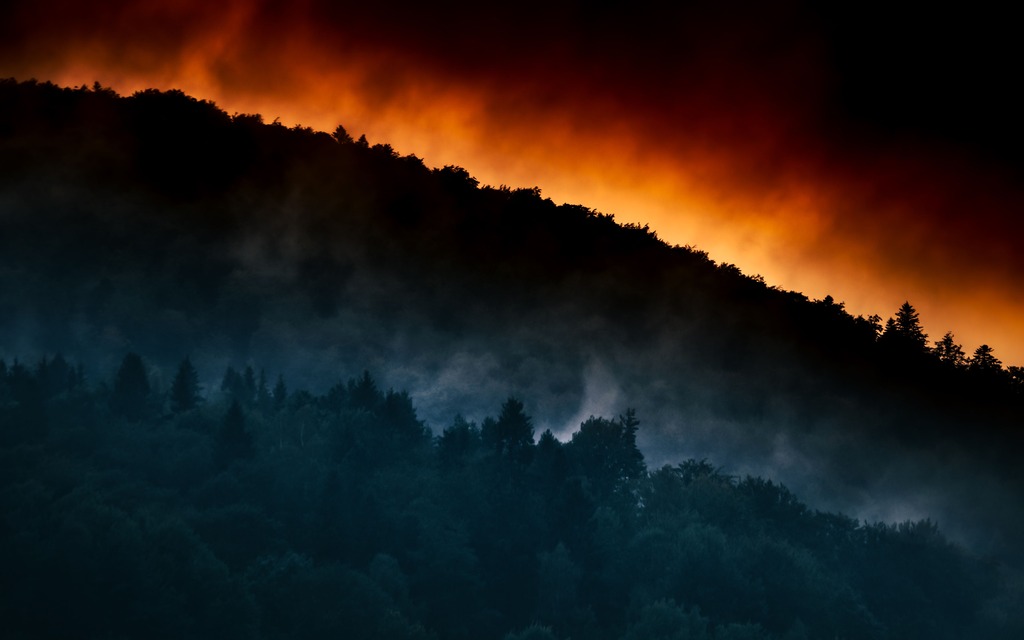
Summer in Galicia comes with a backdrop most people don’t expect when they picture this part of Spain: wildfire season. We’ve now seen it twice, both times as smoke rising from somewhere in the distance, never close enough to feel threatened but close enough to notice how quickly everyone around here reacts to it.
Living near the Miño has given us a strange front row seat to part of the response. The river is one of the places where the water bombers, the yellow and red firefighting planes, come to scoop up water before heading back to wherever the fire actually is. We’ve watched them do this a handful of times now, low over the water, banking hard right after they’ve filled their tanks. It’s the kind of thing that makes you stop whatever you’re doing and just watch.
What’s struck us most is the speed of the response. Both times we’ve seen smoke on the horizon, the planes were in the air within what felt like minutes, not hours. Last year’s fires in Galicia were bad enough that they made international news, and everyone we’ve spoken to locally remembers it clearly. This year, so far, the sense we get is that the authorities are throwing resources at fires early and aggressively, precisely to avoid a repeat of that. Whether that’s a deliberate shift in strategy after last year or simply how it always works here, we can’t say for certain. But the contrast between a small plume of smoke and a full-blown crisis seems to come down almost entirely to how fast the first response is.
We haven’t had to evacuate, we haven’t smelled smoke in the village itself, and nothing has come close enough to our own property to worry about directly. But living rurally here means the risk is always somewhere in the background during the dry months, the way snow is in the background for people living in the mountains elsewhere. It’s not something that keeps us up at night, but it is something we’re aware of every time the wind picks up on a hot, dry afternoon.
From what we’ve read since, the speed we’ve witnessed isn’t a coincidence. Galicia runs an annual wildfire prevention and response plan, known as Pladiga, and the region has formally marked 2026’s high risk period as running from the first of July through the end of September. When a fire breaks out, the response tends to be layered rather than relying on one type of resource: forest rangers and ground crews with pump-equipped engines arrive alongside aerial support, and the regional government coordinates with national bodies for extra planes and helicopters when a fire grows large enough. The planes we see scooping water from the Miño fit into that same system, since aircraft that can refill from a nearby river or reservoir turn around far faster than ones that have to return to an airport to reload. On top of the emergency response itself, there’s also a preventive side we hadn’t fully appreciated before moving here, with local campaigns encouraging people to clear dry vegetation and flammable material from around their homes well before summer arrives. Given how devastating the fires were last year, none of this feels like overkill.