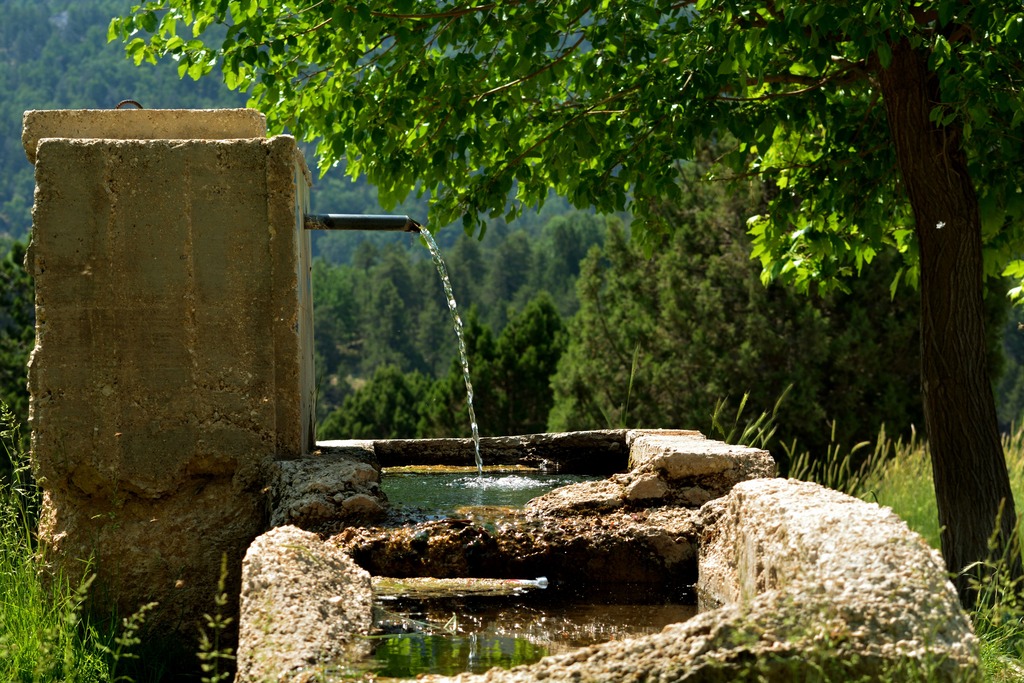
Drive through almost any village in rural Galicia and you’ll spot it: a stone fountain, often centuries old, with a small trickle of water running into a basin, and more often than not, someone filling up bottles or jugs. Even in households that have their own well, it’s common to see people walking to the village fonte instead of turning on the tap at home. It isn’t nostalgia. There are practical reasons behind it, and they come down to taste, safety, and habit.
Taste and Water Quality
The most immediate reason is simply that fountain water tends to taste better. It’s fresher and softer than what often comes out of a private well, which can carry a mineral edge or a faint smell that people notice immediately once they’re used to the alternative.
Private wells are also more prone to problems that affect taste and clarity. Many are shallow, and shallow wells absorb rainwater faster rainwater that has often passed over farmland or near livestock stables before soaking into the ground. That runoff can carry contamination straight into the water table a private well draws from.
We have our own well, and out of curiosity we tested the water with one of the home test kits you can order online. The result was reassuring: clean water, with barely any limescale at all. And yet, even with a well that tests well, we still notice that drawing water from the village fountain feels nicer than anything from our own tap much like it seems to for every farm around us, well or no well.
Safety and Tradition
Beyond taste, there’s a real safety consideration. A village fountain typically draws from deep underground, through rock, and flows continuously rather than sitting static in a shaft. That constant flow is itself a kind of natural filtering and refreshing that a still well simply doesn’t have.
There’s also a social layer to it. A village fountain has usually been used, watched, and trusted by the same community for generations. That collective familiarity functions almost like an informal quality check if something were wrong with the water, the whole village would know quickly, because everyone drinks from the same source.
And then there’s simple habit. “Going to the fountain” isn’t just an errand in rural Galicia it’s a small, recurring social moment, one of those quiet rituals that structures daily life in a village of a few dozen people.
The Bigger Picture
None of this means private wells are inherently unsafe, and ours is proof of that. But it does explain a pattern that can look strange to newcomers at first: households with running water and a clean well of their own, where someone still walks to the fountain with a couple of empty bottles. Once you understand the reasoning taste, contamination risk, and a source that’s been trusted for generations it stops looking like an odd habit and starts looking like common sense.