
Why So Many Houses in Galicia Stand Empty
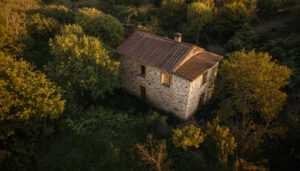
Drive through almost any parish in the Ribeira Sacra and you will pass at least one house with the shutters closed, the garden gone to bramble, and a roof slowly giving way to moss. Sometimes it is one house. Sometimes it is half the village. New arrivals often read this as abandonment, as a place in decline, as evidence that rural Galicia is dying. We understood it that way ourselves, at first. It is only once you learn the history that the picture changes, and the empty houses stop looking like failure and start looking like something closer to a pause.
Galicia has been exporting its people for a century and a half. It started in the second half of the 1800s, when land here was split into plots too small to support a family — a direct result of inheritance laws that divided farms equally among children generation after generation, until what remained was not a farm but a garden. Cuba and Argentina absorbed the first wave, and later Uruguay and Brazil, drawing on family networks and Spanish-speaking communities that made the crossing easier than it sounds. By the early twentieth century the emigration had become so identified with this region that in Buenos Aires and Havana, “gallego” stopped meaning someone from Galicia specifically and simply came to mean a Spaniard, full stop. That is not a minor linguistic footnote. It tells you how many people left, and how visible they were when they got where they were going.
The Spanish Civil War added a second layer, sending political refugees down the same routes, mostly to Argentina and Mexico. Then, under Franco, the pattern shifted again: Latin America’s own economic troubles made it a less obvious destination, so the emigration turned toward Europe instead. Switzerland, Germany, France, and the Netherlands all took in Galician workers through the 1950s, ’60s, and ’70s. This is the wave that hollowed out the villages we live among now. It was not one dramatic departure but a slow bleed, decade after decade, of the people who would otherwise have kept these houses lived in.
What that leaves behind is not a mystery, once you know it. A house stands empty because the family that built it now has descendants in Buenos Aires, or Bern, or Rotterdam, who inherited a stone building attached to a place they visit once a year, if that. Nobody sells, because land here carries weight beyond its market value, and selling the family home is not a small decision. Nobody moves back permanently either, because the jobs their grandparents left to find abroad never stopped being better than what the village offers. So the house sits. Not neglected in the sense of unloved — often the roof is patched, the garden gate still locked, someone still comes back every August — but unoccupied for eleven months of the year.
This is also why “abandoned” is the wrong word more often than it looks. Many of these houses are waiting, not derelict. There is a whole category of return migration here, a slow trickle of grandchildren and great-grandchildren of emigrants who eventually do come back sometimes to retire, sometimes because a changed economy or a pandemic made rural life look different than it did to their parents. Spain’s provisions for descendants of emigrants make that legal return easier than people expect, and we have met more than one neighbour whose Galician surname and Galician passport both trace back to a grandfather who left for Caracas in 1955.
None of this means the empty houses aren’t a real issue depopulation is depopulation, and a parish with three full-time residents and thirty roofs is not thriving by any reasonable measure. But it is worth knowing, if you are looking at rural Galicia and wondering what happened here, that the story is not collapse. It is a century and a half of people leaving to survive, some of whom are only now, slowly, finding their way back to a house that was always still theirs.