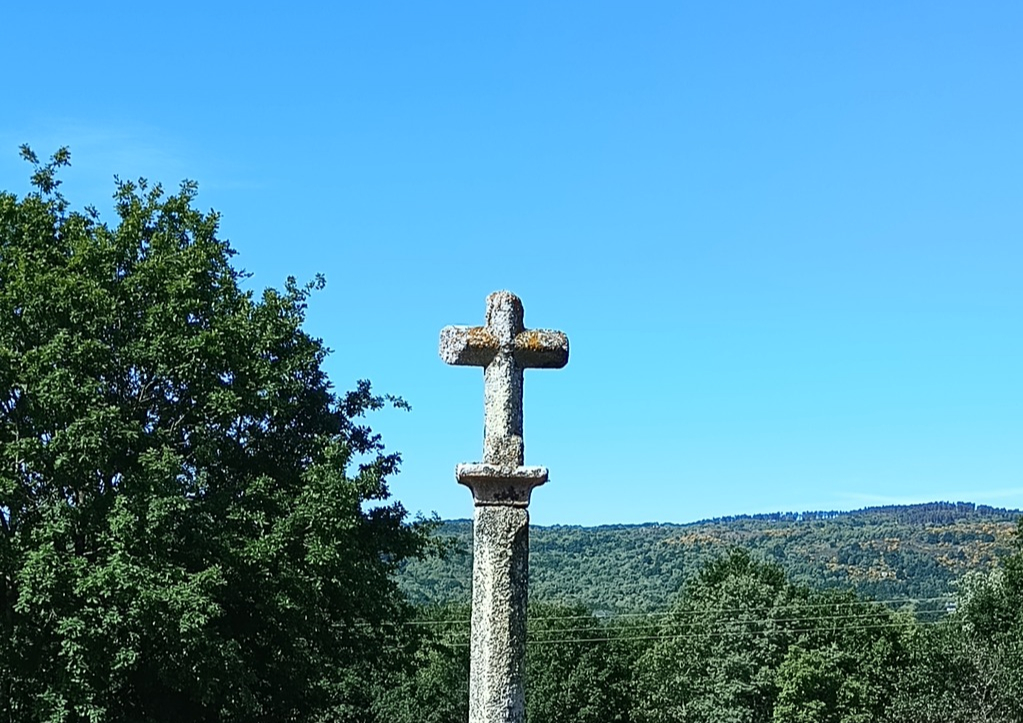
When we first moved to Ribeira Sacra, we started noticing them almost immediately. A tall stone cross on a granite shaft, standing quietly at a crossroads, in the middle of a village square, or seemingly in the middle of nowhere along a country lane. We saw them everywhere, and for a while we had no idea what they were or why they were there. It turns out these crosses, called cruceiros, are one of the most distinctive and least explained features of the Galician landscape.
What Exactly Is a Cruceiro
A cruceiro is a stone cross mounted on a tall, slender column, usually set on a stepped base. Most are carved from granite, the same material used for the horreos we’ve written about before. They’re not rare monuments tucked away in museums; they’re a working part of everyday village life, standing at crossroads, in front of churches, on village squares, and along old paths. There are thought to be well over ten thousand of them scattered across the region, which explains why we kept running into them wherever we went.
Two Layers of History Under One Cross
The more we read about cruceiros, the more it became clear that they carry two very different stories at once. On one side, there’s a Christian layer: crosses raised to mark holy ground, commemorate an event, or serve as public penance for a sin. On the other side, there’s an older, pre-Christian layer. Some historians trace the tradition back to Roman times, when altars were dedicated to the lares, spirits believed to protect the home and the road. When Christianity spread through Galicia, crosses were placed over or near these older sacred spots, effectively rewriting the meaning of a place people had already treated as significant for centuries.
For the local population, cruceiros weren’t only religious markers handed down by the church. They also carried their own folk meaning, tied to protection from the supernatural and to a mythology that existed alongside official Catholic belief. The church used them to sanctify the landscape; villagers used them to protect themselves.
More Than Decoration: What They Were Actually For
Once we understood the background, the placement of cruceiros started to make a lot more sense. They were used as waymarkers on roads and pilgrim routes, which matters in a region crisscrossed by the Camino de Santiago. They marked boundaries between parishes or properties. They were raised as an offering, a request for a miracle, or as thanks after one had supposedly been granted. And in some cases, they served a much darker purpose: protecting travelers at crossroads from the Santa Compaña, the ghostly procession of souls that features in so much Galician folklore.
That last point connects directly to something we’ve written about before. If you’re already familiar with our piece on Galician folk beliefs, you’ll recognize the same instinct here: put something at the dangerous point in the landscape, whether that’s a crossroads or a doorway, to keep whatever might be wandering there at bay.
Reading a Cruceiro Like a Local
Not all cruceiros look the same, and once you start paying attention, the differences are easy to spot. Older ones, some dating back to the fourteenth century, tend to have simpler, more weathered carvings. Coastal cruceiros often follow a specific orientation: the figure of Christ facing inland, toward the village, and the Virgin facing out to sea, symbolically watching over sailors and fishermen. Inland versions, especially near churches or old pilgrim routes, are more likely to carry biblical scenes carved directly into the shaft or base, meant to teach as much as to protect.
Why It’s Worth Noticing Them
We’ve walked past dozens of cruceiros without a second thought before we knew any of this. Now we stop, look at the orientation, check the base for a date or inscription, and try to guess whether it marks a boundary, a crossroads, or a spot someone once considered dangerous. It’s a small habit, but it’s changed the way we experience even a short walk through the village. If you’re spending time in rural Galicia, it’s one of those details that, once you notice it, you can’t stop noticing.